
By Jeremy
Published September 26, 2026
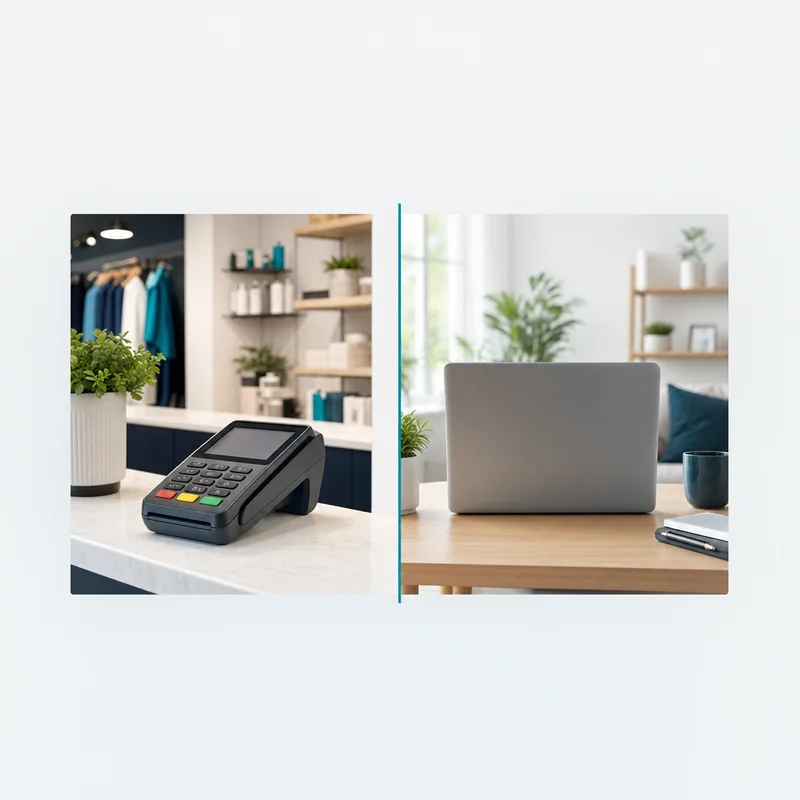
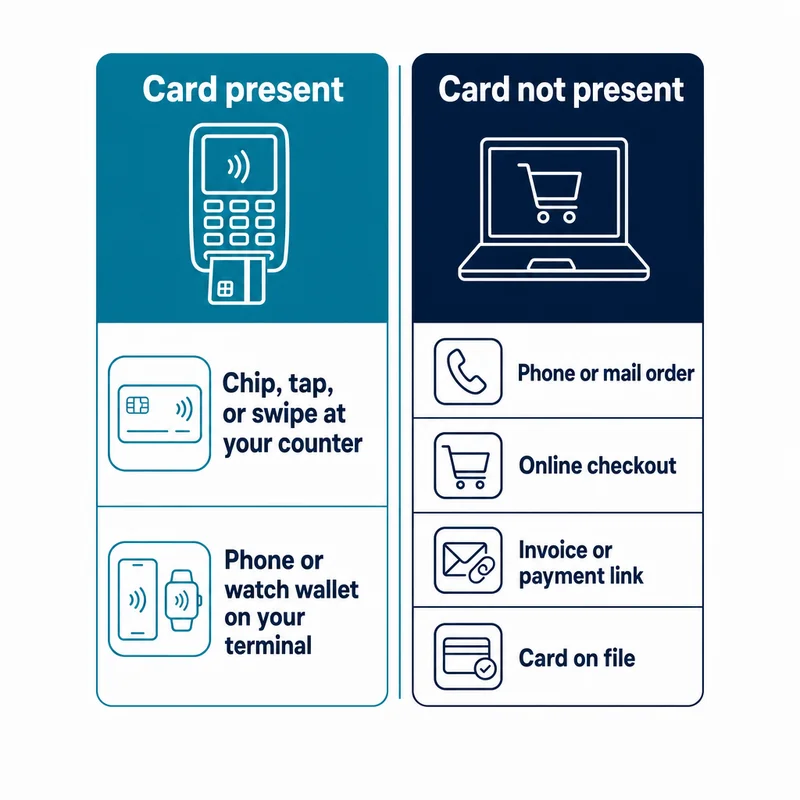
A card present transaction is one where the customer and the card, or a phone wallet holding it, are at your checkout and your terminal reads it by chip, tap, or swipe. A card not present transaction is everything else: online checkouts, phone and mail orders, invoices paid through a link, and charges to a card you keep on file. The label matters because it can change the interchange rate on the sale and who absorbs the loss if the sale turns out to be fraud.
Below is where the line falls in tricky cases, the rate gap on Visa’s current schedule, who carries fraud losses, and how to lower card not present risk and cost.
What counts as card present and card not present
The card networks define these terms precisely. The Visa Core Rules, in the edition dated April 18, 2026, call a sale card present only when all three of these are true:
- The card and the cardholder are physically there: at your premises, with you in person if your business doesn’t trade from a fixed location, or at an unattended terminal such as a kiosk.
- The sale is completed on an acceptance device (a terminal or reader) or a manual imprinter.
- The sale is not made with a stored credential, meaning card details saved to process future charges.
If any one is missing, Visa classes the sale as card absent, its term for card not present. Here is how common situations sort out:
| How the sale happens | Usually classed as | Why |
|---|---|---|
| Chip insert, tap, or swipe at your counter | Card present | The card, the customer, and your terminal are in the same place |
| Customer taps a phone or watch wallet on your terminal | Card present | Visa’s rules count a digital application that holds the card as a card |
| You take a tap on your own phone or tablet with a payment app | Card present | Visa treats a merchant’s NFC-enabled phone running an acceptance app as the acceptance device |
| Card keyed in at the counter because the chip won’t read | Card present, but key-entered | The card is there, but the sale gives up the chip read that protects you in a fraud dispute |
| Phone or mail order | Card not present | Neither the card nor the customer is at your terminal |
| Online checkout, including a phone wallet used in an app or on a website | Card not present | The sale happens over the internet, not on your acceptance device |
| Invoice or payment link the customer pays online | Card not present | The customer enters the card on a web page |
| Charging a card you keep on file, even with the customer standing there | Card not present | Visa’s definition treats a sale made with a stored credential as card absent |
Two rows surprise owners: a card keyed at the counter is still card present but can be priced like a remote sale, and a card on file is card absent even with the customer in front of you.
If you take phone orders regularly, our guide to what a virtual terminal is and how phone orders are keyed covers the daily routine. For selling online, see our page on e-commerce payment gateways and processing.
Why card not present sales cost more in interchange
Interchange is a fee paid between the banks on each sale, and it goes to the bank that issued the card. Visa’s schedule notes that merchants don’t pay it directly; they pay a merchant discount to their own financial institution.
The Visa USA Interchange Reimbursement Fees schedule, effective April 18, 2026, lists separate card present and card not present rates. Here is how they compare for a few common card types:
| Visa card and program | Card present | Card not present |
|---|---|---|
| Traditional Rewards credit | 1.65% + $0.10 | 2.04% + $0.10 |
| Visa Signature Preferred credit | 2.10% + $0.10 | 2.50% + $0.10 |
| All other consumer credit products | 1.51% + $0.10 | 1.89% + $0.10 |
| Traditional Rewards credit, Small Merchant program | 1.43% + $0.10 | 1.73% + $0.10 |
| Debit from an exempt issuer (under $10 billion in assets) | 0.80% + $0.15 | 1.65% + $0.15 |
| Debit from a regulated issuer ($10 billion or more in assets) | 0.05% + $0.21, plus $0.01 if eligible | 0.05% + $0.21, plus $0.01 if eligible |
The first three rows are Visa’s general consumer credit rates. Visa also publishes separate rates for specific industries and programs, so your own mix may look different. The Small Merchant program has a volume maximum of $280,000 in gross Visa consumer credit sales, based on 12 months of Visa activity ending September 30, 2024, with full details in Visa’s rate qualification guide.
Regulated debit is the one row where presence doesn’t change the rate. Federal Regulation II caps debit interchange for large issuers at $0.21 plus 0.05% of the sale, plus $0.01 when the issuer meets the Fed’s fraud-prevention standards. That cap is still in effect but under legal challenge: a federal court in North Dakota ruled against it in August 2025 and put its ruling on hold while the Federal Reserve appeals, and the Fed has separately proposed lowering it.
Exempt debit is the opposite: a card keyed in at your counter falls in Visa’s retail key entry category at 1.65% + $0.15, the same as a card not present sale and more than double the percentage for a chip or swipe.
Worked example: one order, two ways
Say a customer places a $200 order with a Visa Traditional Rewards credit card and the sale qualifies for Visa’s general rates. If they pay at your counter with the chip, interchange in this example is 1.65% of $200 plus $0.10, or $3.40. If the same order comes in through your website, it is 2.04% of $200 plus $0.10, or $4.18. That is $0.78 more on one sale in this example, before your provider’s own markup or any network fees.
How much of this you see depends on your pricing. On interchange-plus pricing, interchange passes through at cost, so a higher card not present rate flows straight into what you pay. On flat or tiered pricing, check your agreement for a separate rate on keyed or online sales.
Why card not present is the riskier channel
Remote sales also carry more fraud. The Federal Reserve’s latest report on debit card interchange, costs, and fraud losses, covering 2023 and last updated in January 2026, shows the pattern:
- Card not present sales were 34.4% of all U.S. debit and prepaid card transactions in 2023.
- Among issuers with at least $10 billion in assets, card not present fraud made up 54.3% of debit card fraud losses, more than any other fraud type.
- Merchants absorbed 65.1% of those card not present fraud losses, compared with 49.9% of fraud losses overall.
The Fed also explains how the balance shifted: once chip cards made in-person fraud harder, fraud moved toward card not present, or remote, payments. These figures cover debit cards only.
Who pays for fraud: EMV chip versus card not present
In person: the EMV liability shift
Chip cards follow the EMV standard. As Visa’s June 2016 chip migration announcement recounts, Visa announced a U.S. liability shift in 2011 that took effect in October 2015. Since then, the cost of counterfeit fraud falls on whichever party, the merchant or the card issuer, has not implemented chip technology.
The Dispute Management Guidelines for Visa Merchants (June 2024) show how this plays out. A counterfeit fraud dispute can come back to you when a chip card wasn’t processed at a chip terminal or the full chip data wasn’t sent. If the chip was read at a chip terminal, you respond with proof of that.
Keyed sales at the counter have their own rule: the guidelines call for an imprint from a manual imprinter, even when the card and terminal both handle chips. Without one, a fraudulent keyed sale can be disputed back to you even if it was approved and signed.
Remote: the merchant usually carries the loss
When a cardholder says they didn’t make an online, phone, or mail order purchase, Visa’s dispute condition for card absent fraud applies, and your defenses are narrow: the sale was authenticated with Visa Secure, or you have specific compelling evidence, such as earlier undisputed purchases by the same customer that match on details like the device or IP address.
Visa Secure is Visa’s version of 3-D Secure, a check that lets the card issuer confirm the shopper during online checkout. Visa’s guidelines say a participating merchant is protected from certain fraud-related disputes when the cardholder is authenticated, or when the issuer or cardholder doesn’t take part, as long as the sale is processed correctly. A merchant that doesn’t attempt authentication is not protected, and Visa notes the rules can vary by region.
Visa Secure is built for e-commerce, so it doesn’t help with phone or mail orders.
| Situation | Where fraud risk usually lands |
|---|---|
| Chip card read at a chip terminal, full chip data sent | You can answer a counterfeit fraud dispute with proof the chip was read |
| Chip card run on a terminal that can’t read chips | A counterfeit fraud dispute can be sent back to you |
| Card keyed at the counter with no manual imprint | A fraud dispute can come back to you even with an approval and a signature |
| Online sale authenticated with Visa Secure | Protected from certain fraud-related disputes if processed correctly |
| Online, phone, or mail order with no authentication | You carry it unless you have compelling evidence |
For a fuller playbook on keeping disputes down, see our guide to chargeback prevention.
How to lower card not present fraud and cost
You can’t make an online order card present, but these steps reduce fraud, strengthen your position in disputes, and in some cases lower the rate.
- Turn on 3-D Secure for online checkout. Visa describes 3-D Secure as a way to reduce fraud risk and shift liability away from the merchant.
- Ask for the security code and use address verification. CVV2 (the security code on the card) and the Address Verification Service (a billing address check with the issuer) are on Visa’s list of card absent fraud tools. On their own, they carry only narrow dispute protections.
- Authorize every remote sale. Visa’s guidelines say to request authorization for all mail order, phone order, internet, and recurring transactions, regardless of the dollar amount.
- Flag each sale correctly. Visa’s guidelines list a card absent sale that wasn’t identified as an internet, mail, or phone order as one of the common causes of card present fraud disputes.
- Ask about network tokens. A network token stands in for the card number. Visa’s April 2026 schedule lists small card not present incentives, from 0.05% to 0.15% off the rate, for qualifying sales that use an EMV payment token, Visa’s Digital Commerce Authentication Program, or both. Visa notes they are subject to change.
- Use a business name customers recognize. Visa lists an unclear or confusing merchant name among the most common causes of card absent fraud disputes.
- Send Level 2 and Level 3 data on business sales. Corporate and purchasing cards have their own section of Visa’s schedule. If you sell to other businesses, our guide to Level 2 and Level 3 credit card processing explains how sending extra transaction data can affect those rates.
- Read the chip or tap whenever the card is there. At events or in the field, a mobile reader or tap to pay on a phone keeps the sale card present.
PCI compliance looks different too
How much PCI work you carry depends on where card data travels. The PCI Security Standards Council’s January 2025 update on SAQ A says that self-assessment questionnaire includes only the requirements that apply when card handling is completely outsourced to validated, compliant third parties. It is for card not present merchants, e-commerce or mail and telephone order, that don’t store, process, or transmit card data electronically on their own systems or premises.
A hosted payment page run by a compliant provider, which keeps card numbers off your own systems, can fit that description. Typing phone orders into your own computer or saving card numbers in a spreadsheet does not.
The Council also notes that it doesn’t set validation requirements; the card brands and acquirers do. Your provider can confirm which questionnaire applies to you, and our PCI compliance overview covers the basics.
What to check on your statement and ask your provider
Most businesses take both kinds of sales. A recent statement and your agreement show how that mix is priced and protected. These questions are a good place to start:
- Does my statement separate card present and card not present volume, and what share of my sales is each?
- Are counter sales being keyed when the chip or a tap could be read, and how often does my terminal fall back to swipe or key entry?
- Does my agreement list a separate, higher rate for keyed or online sales?
- Does my online checkout use 3-D Secure, and does it support tokens and the Visa incentives tied to them?
- Which PCI questionnaire do I validate with, and does it still fit how I take phone and online orders?
If you’d like a second set of eyes, PayPoint Systems, an independent merchant services provider in Northwest Indiana, can walk through a statement with you and show where your card present and card not present sales are landing.
Frequently Asked Questions
What does card not present mean?
Card not present means the card and the cardholder are not physically at your terminal when the sale is made. Online checkouts, phone and mail orders, invoices paid through a link, and charges to a stored card on file all count. Visa’s rules call this a card absent environment. The label matters because card not present sales often carry higher interchange, and the merchant usually absorbs the loss if the sale turns out to be fraud.
Can you give me an example of a card not present transaction?
A customer buying from your website is the most common example. Others include a customer reading their card number to you over the phone, a mail order form with card details, an emailed invoice paid through a payment link, and a monthly charge to a card you keep on file. Even if the customer is standing at your counter, charging their stored card still counts as card not present under Visa’s rules.
Is Apple Pay a card present or card not present transaction?
It depends on where the customer uses it. Apple Pay works in stores, on websites, and in apps. When a customer taps a phone or watch on your terminal, the sale is card present, because Visa’s rules treat a digital wallet as the card and the tap happens on your acceptance device. When the same customer pays with Apple Pay inside an app or on a website, the sale is card not present.
Why do card not present transactions cost more?
Card networks set separate interchange rates for card present and card not present sales, and the remote rates are usually higher. On Visa’s schedule effective April 18, 2026, a Traditional Rewards credit card at Visa’s general rates runs 1.65% + $0.10 when present and 2.04% + $0.10 when not. Remote sales also carry more fraud: Federal Reserve data for 2023 shows card not present fraud was the largest share of debit card fraud losses at large issuers.
Is a keyed-in transaction card present or card not present?
If the customer and card are at your counter and you type in the number, Visa still treats it as card present, but key-entered. It loses the protection of a chip read. Visa’s guidelines say a keyed card present sale needs a manual imprint of the card, or a fraud dispute can come back to you. On debit cards from exempt issuers, keyed sales also carry the same Visa interchange rate as card not present sales.
Who is liable for card not present fraud?
Usually the merchant. When a cardholder disputes an online, phone, or mail order sale as fraud, the merchant carries the loss unless it can show the sale was authenticated or has specific compelling evidence. Visa’s guidelines protect merchants from certain fraud-related disputes on e-commerce sales authenticated with Visa Secure, its 3-D Secure program. Federal Reserve data for 2023 shows merchants absorbed 65.1% of card not present debit fraud losses at large issuers.
Is tap to pay on a phone card present?
Yes. When you accept a contactless card or wallet on your own phone or tablet through a payment app, the card and the customer are with you and the phone acts as your acceptance device. Visa’s rules call this a Tap to Phone solution: an NFC-enabled phone or tablet, owned or controlled by the merchant, that runs an application to act as an acceptance device. Typing a card number into the same phone is key entry, not a tap.
Related guides
- Effective Rate vs Headline Rate: What You Are Actually Paying
- Merchant Statement Fee Dictionary: What Every Line Item Means
Sources
- Visa USA Interchange Reimbursement Fees (effective April 18, 2026), Visa
- Visa Core Rules and Visa Product and Service Rules (18 April 2026), Visa
- Dispute Management Guidelines for Visa Merchants (June 2024), Visa
- 2023 Interchange Fee Revenue, Covered Issuer Costs, and Covered Issuer and Merchant Fraud Losses Related to Debit Card Transactions, Board of Governors of the Federal Reserve System
- Visa to Help Accelerate EMV Chip Migration and Support Merchants (June 16, 2016), Visa
- 3D Secure: your guide to safer transactions, Visa
- Important Updates Announced for Merchants Validating to Self-Assessment Questionnaire A (January 30, 2025), PCI Security Standards Council
- Apple Pay, Apple
- Regulation II: Average Debit Card Interchange Fee by Payment Card Network (last updated December 19, 2025), Board of Governors of the Federal Reserve System
- Debit Card Interchange Fees and Routing, proposed rule, Federal Register document 2023-24034, 88 Fed. Reg. 78100 (November 14, 2023), Board of Governors of the Federal Reserve System, Federal Register
- Corner Post, Inc. v. Board of Governors of the Federal Reserve System, No. 1:21-cv-00095, Amended Judgment, ECF No. 87 (October 27, 2025), U.S. District Court for the District of North Dakota, via CourtListener
- Corner Post, Inc. v. Board of Governors of the Federal Reserve System, No. 1:21-cv-00095, Amended Notice of Appeal, ECF No. 88 (October 28, 2025), U.S. District Court for the District of North Dakota, via CourtListener
This article is general information for business owners, not legal, tax, or accounting advice. Card brand rules, interchange schedules, and processor agreements change; confirm specifics against your own statement and your own signed agreement.