
By Jeremy
Published September 26, 2026

Chargeback prevention means removing the reasons a customer would call their card issuer instead of you: a charge they don’t recognize, a refund policy they never saw, an order that never arrived, or a stolen card. Visa’s own dispute management guide for merchants says most disputes can be traced to transaction-processing mistakes and prevented with training and attention to detail. Many of the fixes are operational: clearer descriptors, better receipts, visible refund terms, fulfillment updates, and fraud checks.
The volume is growing: Visa says it processed 106 million disputes worldwide in 2025, a 35% increase since 2019. This guide covers what to set up and collect before a dispute happens. If you’re already holding a chargeback notice, the merchant chargeback dispute playbook walks through responding to one.
Why chargebacks happen: three root causes
A chargeback is a card sale reversed by the cardholder’s bank, called the issuer, after the cardholder disputes it. Mastercard’s Chargebacks Made Simple guide notes that only the issuer can start one. Visa sorts disputes into four categories (fraud, authorization, processing errors, and consumer disputes), and Mastercard uses a similar four.
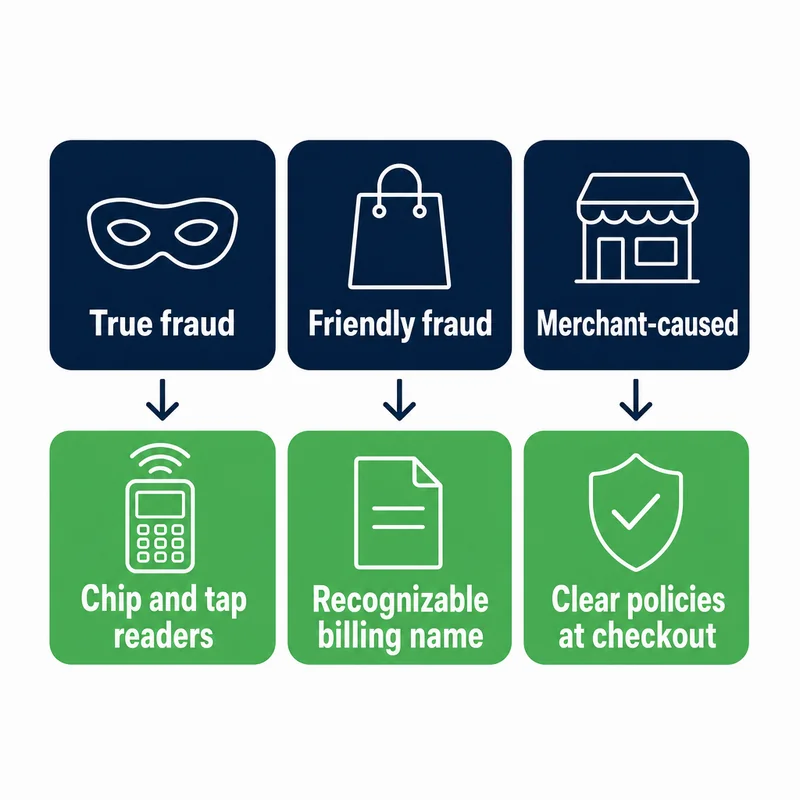
Grouping disputes by who caused them points straight to the fix.
| Root cause | What it looks like | Where prevention happens |
|---|---|---|
| True fraud | Someone uses a stolen card or card number, and the real cardholder reports a charge they never made. | Chip and tap readers in person; address, security-code, and 3-D Secure checks online |
| Friendly fraud | The cardholder disputes a purchase they or their household made, because they forgot it, didn’t recognize it, or want to reverse it on purpose. | A recognizable billing name, clear receipts, order details shared with the bank, and saved proof of who ordered |
| Merchant-caused | An unfamiliar billing name, a refund policy the customer never saw, a late delivery, a duplicate charge, or a surprise renewal. | Clear policies at checkout, delivery updates, clean processing, and fast refunds |
Confusion drives a lot of friendly fraud. A 2026 Mastercard report on a Datos Insights survey of 3,576 people in five countries who use mobile banking apps or subscription services found that 48% had disputed at least one charge they later realized was legitimate. Among the US respondents, 52% had not recognized at least one purchase, and 63% of those reported the unfamiliar charge as fraud.
A checklist for merchant-caused disputes
These disputes are the most preventable, because the cause sits inside your own business. The card below sums up the habits.
Use a billing name customers recognize
Your descriptor is the business name, city, and state on the customer’s card statement. If it shows a legal entity or parent company customers don’t know, honest people may report the charge as fraud. Visa’s guide suggests confirming your doing-business-as name, city, and state with your acquirer, then buying something on your own card at each location to see how the charge reads.
Show refund and cancellation terms where the customer pays
Visa’s guide says the cardholder must receive your return, refund, and cancellation policy at the time of purchase. Online, that means in the checkout sequence with a click-to-accept box or button, or on the checkout screen near the submit button. In person, the policy belongs near the signature line on the receipt or contract. Keep the version of your terms that was live on each order date, along with the customer’s acceptance record.
Keep customers informed until the order is done
For card-not-present sales, Visa’s guide says not to deposit the transaction until the goods have shipped, to tell the customer in writing when an order is delayed or out of stock, and not to substitute another item without the customer’s agreement. A receipt at checkout and a tracking or completion notice close the loop.
Process each sale cleanly
Visa’s guide recommends entering each sale once, depositing transaction receipts preferably within one to five days of the sale, and depositing credits the same day you issue them.
Make recurring billing predictable
Mastercard’s subscription standards call for a confirmation at sign-up that states the terms and how to cancel, plus a simple online way to cancel, and Mastercard recommends a receipt after every billing. Visa’s guide says to cancel a recurring charge as soon as the customer asks, confirm the cancellation in writing, and stop billing from that point.
Answer refund requests before they become disputes
Visa’s guide says that when a cardholder with a valid complaint contacts you directly, you should act promptly and issue a credit. A prompt refund, issued before the cardholder files a dispute, can prevent a chargeback, but a fraud report the issuer has already filed can still count toward Visa’s monitoring ratio. Ask your acquirer how refunds and pre-dispute alerts are counted. List a phone number and email on receipts and your website so customers reach you before they reach their bank.
Fraud tools that stop stolen-card disputes
True fraud is where your equipment and checkout settings do most of the work.
| Tool | Where it applies | What it does |
|---|---|---|
| Chip and contactless (EMV) | In person | Reads the chip or a tap instead of the stripe. Under Visa’s rules, a counterfeit chip card accepted at a terminal that can’t read chips can leave the fraud loss with you. |
| Correct entry mode | In person and by phone | Visa’s guide calls for a manual imprint if you must key in a card at the counter. Phone and mail orders should be flagged as card-not-present, not run as counter sales. |
| Address Verification Service (AVS) | Online and phone | Compares the billing address the buyer enters with the one the card issuer has on file. |
| Card security code (CVV2 on Visa cards) | Online and phone | Checks the code printed on the card, a sign the buyer has the card and not just the number. |
| 3-D Secure (Visa Secure on Visa cards) | Online | Lets the issuer confirm the buyer’s identity, often behind the scenes. Visa’s guide says successfully authenticated, correctly processed transactions are protected from fraud-related disputes. |
Visa’s guide notes that the liability rules for Visa Secure can vary by region. These tools sit alongside your PCI compliance duties, which govern how you store and protect the card data you collect.
Save the data that identifies repeat customers
Online, save the details that tie an order to a known customer: IP address, device ID, account or login ID, and delivery address. Visa’s Compelling Evidence 3.0 rules match those data points against a customer’s earlier orders that were not reported as fraud, which helps separate a real customer from a thief, and Visa’s monitoring ratio leaves out fraud reports that qualify under those rules. If your e-commerce payment gateway doesn’t save them today, it’s worth asking whether it can.
Card testing: fraud that arrives as a flood of small charges
Card testing, also called card cycling, is when criminals use automated scripts to run stolen card numbers through a checkout with small purchases or donations to see which cards still work. Mastercard notes that the decline fees stack up quickly, your acquirer may flag your account as risky, and the charges that go through can come back as chargebacks.
Visa now watches for it directly. Its monitoring program tracks enumeration, which Visa describes as a rapid, brute force card testing attack at scale. Visa’s fact sheet sets enumeration thresholds of 20% of a merchant’s authorization attempts and 300,000 enumerated transactions in a month, and acquirers are required to take proactive steps to keep merchants below them.
Warning signs
- A sudden influx of authorization requests for inexpensive items or tiny donations
- A spike in declined transactions
- Many different card numbers tried by the same user, account, or device
- An unexplained jump in authorization volume or false declines
What to do about it
- Add a CAPTCHA or similar bot check to checkout and donation forms.
- Turn on 3-D Secure for online card payments.
- Ask your gateway provider about device and behavior screening that flags many card attempts from one source.
- Call your processor as soon as you spot an attack, so they can help you find the blocking or filtering options available.
Pre-dispute alerts and order-detail programs
Between a confused customer and a filed chargeback, there is now a window where the problem can still be settled. Both networks offer programs that work in that window.
| Program | Network | What it does |
|---|---|---|
| Order Insight | Visa | Shares itemized purchase details with the card issuer and the customer’s banking app, so the customer recognizes the purchase instead of disputing it. An April 2026 update lets merchants share Compelling Evidence 3.0 data through it. |
| Resolve | Visa | Decides pre-dispute cases from participating issuers using rules you set, and refunds the customer when a case is resolved. Visa says it covers Visa and non-Visa pre-disputes. |
| Ethoca Alerts | Mastercard | Sends near real-time notices of issuer-confirmed fraud and disputes, so you can stop the shipment and refund. |
| Ethoca Consumer Clarity | Mastercard | Shows enhanced purchase details to cardholders in their bank’s digital channels. |
| Visa Dispute Resolution Network | Visa | A newer pre-dispute service, in pilot, with general availability planned for late 2026. |
Visa’s rules reward using these tools: its fact sheet says the monitoring ratio excludes disputes resolved through pre-dispute solutions, depending on the timing of Visa’s monthly data pull. The catch: an alert usually ends in a refund, which is still lost revenue, so use these programs on top of the fixes above, not instead of them.
How Visa and Mastercard monitor your dispute levels in 2026
Both networks watch fraud and disputes merchant by merchant, and they hold your acquirer (the bank that sponsors your merchant account) responsible for acting when a merchant runs high. Here is where the rules stand as of September 2026.
Visa: the Visa Acquirer Monitoring Program
In 2025 Visa folded its separate fraud and dispute programs into the Visa Acquirer Monitoring Program (VAMP). It uses one monthly ratio for card-not-present sales: fraud reports plus disputes, divided by settled transactions. The new thresholds took effect June 1, 2025.
For US merchants, the Excessive Merchant threshold is a ratio of 1.5%, lowered from 2.2% on April 1, 2026, and a merchant must also have at least 1,500 fraud reports and disputes in the month to be identified. Acquirer portfolios are measured separately, at 0.5% (Above Standard) and 0.7% (Excessive), and the merchant thresholds apply when the acquirer is within those limits. Visa advises merchants to ask their acquirer for their VAMP ratio and what the acquirer’s portfolio performance means for them.
Mastercard: the Excessive Chargeback Program
Mastercard’s Security Rules and Procedures (August 2026 edition) require acquirers to monitor each merchant’s chargebacks under the Excessive Chargeback Program, which divides chargebacks received in a calendar month by the previous month’s Mastercard transactions. Merchants over the limits are labeled Excessive or High Excessive Chargeback Merchants, and a companion Excessive Fraud Merchant program watches fraud-related chargebacks.
The thresholds sit in Mastercard’s Data Integrity Monitoring Program manual rather than the public rules. After six months in the program, Mastercard may advise the acquirer on its action plan or require it to undergo a formal risk review.
At the far end, an acquirer that closes an account for excessive chargebacks, as Mastercard defines them, must add the merchant to MATCH, a database acquirers check before signing new merchants. Records stay there for five years.
A worked example
Say you run an online shop that settles 4,000 Visa card-not-present sales in a month. That month you receive 20 disputes, and card issuers file 16 fraud reports on orders that were never disputed. Your ratio is 36 divided by 4,000, or 0.9% (the numbers are illustrative).
That’s under the 1.5% threshold and far below the 1,500 minimum count. Still, fraud reports count even when no dispute is filed, and your acquirer is expected to monitor your numbers all along. If your business falls into a category banks consider high risk, the high-risk merchant accounts page explains how those accounts are set up.
A monthly chargeback prevention routine
Prevention holds up best as a habit. Visa’s guide recommends tracking disputes by reason, as a share of sales, and separately for card-present and card-not-present sales. Once a month, work through this checklist.
- Pull dispute and fraud-report counts from your processor’s portal and compare them with the month’s sales, in person and online separately.
- Sort disputes by category (fraud, authorization, processing error, consumer dispute) and fix the cause behind the largest group.
- Check your statement for chargeback fees; the merchant statement fee dictionary explains how processors label them.
- Make a test purchase whenever your business name, website, or locations change.
- Review the month’s refund requests and how quickly each was answered.
- Check card-testing signals: decline rate, small-ticket authorizations, and bot-check activity.
Questions to ask your provider
- What were my Visa and Mastercard fraud and dispute ratios last month, and where can I see them myself?
- Which monitoring thresholds apply to my account, and will you warn me before I get close?
- Are 3-D Secure, AVS, and security-code checks turned on for my online and phone sales?
- Which pre-dispute alert or order-detail programs can I use, and what do they cost?
- What name, city, and state print on my customers’ statements, and can we make them clearer?
PayPoint Systems is an independent merchant services provider based in Northwest Indiana. We are not the card processor, but we can sit down with your statements and dispute reports and help you get clear answers to these questions.
Frequently Asked Questions
Can a chargeback get you in trouble?
One ordinary chargeback usually doesn’t trigger card network monitoring on its own, though your processor may still review the account under your merchant agreement. A pattern is the bigger risk, because Visa and Mastercard monitor merchants whose fraud and dispute levels run high. In the worst case, if an acquirer closes an account for excessive chargebacks under Mastercard’s rules, it must list the business in MATCH, a database other acquirers check, where records stay for five years.
What is chargeback protection?
Chargeback protection is a loose label, not a card network term. It can mean the protection from fraud-related disputes that comes with successfully authenticating online payments through 3-D Secure, the pre-dispute alert and resolution programs that Visa and Mastercard offer, or a paid service from an outside vendor. Before paying for a service, check which dispute types it covers and how it charges.
What are the best chargeback prevention services available?
There’s no single right answer, because the fit depends on why your disputes happen. Network programs such as Visa’s Order Insight and Mastercard’s Ethoca Alerts target confusion and early fraud warnings. Fraud screening and 3-D Secure in your gateway target stolen cards. Clear billing names, visible refund terms, and quick replies to customers prevent merchant-caused disputes. Start with your own dispute reasons, then pick tools for the largest category.
What is card testing fraud?
Card testing fraud is when criminals use automated scripts to run stolen card numbers through a website with small purchases or donations to find out which cards still work. The usual signs are a burst of small authorization attempts and a spike in declines. It costs merchants decline fees, can make an acquirer see the account as risky, and leads to chargebacks on charges that go through.
What are some examples of card fraud?
For a business, common examples include a counterfeit or stolen card used at the counter, a stolen card number used for an online or phone order, card testing attacks that run many stolen numbers through a checkout, and friendly fraud, where a cardholder disputes a purchase they actually made. Chip readers, address and security-code checks, 3-D Secure, and clear billing each target a different one of these.
What is a chargeback?
A chargeback is a card payment reversed by the cardholder’s bank after the cardholder disputes it, and only the card issuer can start one. The amount is typically taken back from the merchant through the processor. Visa groups disputes into fraud, authorization, processing errors, and consumer disputes, and its merchant guide says most disputes can be prevented with careful processing and training.
Related guides
Sources
- Visa Acquirer Monitoring Program Overview (fact sheet), Visa
- Modernizing payment security: Evolving the Visa Acquirer Monitoring Program, Visa
- Introducing the Visa Acquirer Monitoring Program, Visa
- Dispute Management Guidelines for Visa Merchants (June 2024), Visa
- Visa Unveils New Services to Modernize Dispute Resolution Process (April 1, 2026), Visa
- Order Insight, Visa
- Resolve, Visa
- Security Rules and Procedures: Merchant Edition (4 August 2026), Mastercard
- Simplify operations and reduce disputes with purchase details that matter (with Datos Insights), Mastercard
- How Ethoca helps reduce card-not-present (CNP) fraud chargebacks, Mastercard
- Card testing fraud explained: How merchants can respond, Mastercard
- Revised Standards for Subscription/Recurring Payments and Negative Option Billing Merchants: FAQ, Mastercard
- Chargebacks Made Simple Guide (July 2025), Mastercard
- Chargebacks, Visa
This article is general information for business owners, not legal, tax, or accounting advice. Card brand rules, interchange schedules, and processor agreements change; confirm specifics against your own statement and your own signed agreement.