
By Jeremy
Published September 26, 2026

Void vs refund mostly comes down to one question: has the sale settled yet? A void cancels a card sale while it is still in your open batch, so the sale is never sent through for payment. A refund is a new transaction that sends money back to the customer’s card after the original sale has settled, and it runs through your deposits and your statement like any other transaction.
Neither one is a chargeback, which starts at the customer’s bank, not at your counter. Below, all four sit side by side (void, refund, authorization reversal, and chargeback), followed by the Visa and Mastercard refund rules and a routine for your front-counter staff.
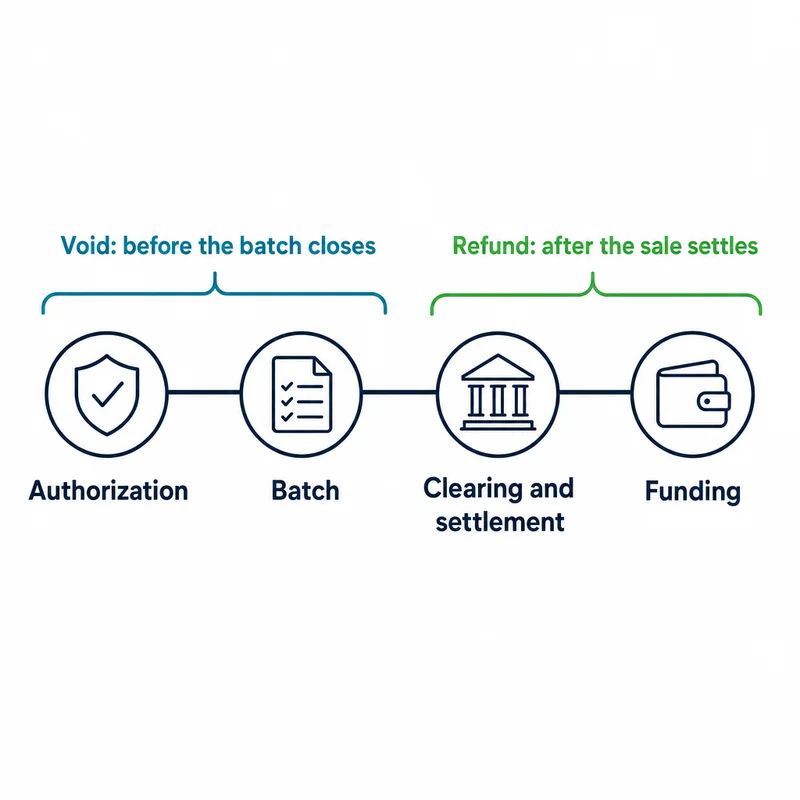
Where a void and a refund fit in the life of a card sale
Every card sale moves through a few stages, and the stage it has reached decides which fix your staff can use.
- Authorization. The terminal asks the customer’s bank to approve the amount. On approval, the bank typically sets that amount aside, which is called an authorization hold.
- Batch. Approved sales collect in the open batch until it is closed, on a schedule or by hand, depending on your setup.
- Clearing and settlement. The closed batch goes through the card networks, the sale posts to the customer’s account, and money moves between the banks.
- Funding. Your deposit arrives, less any refunds, chargebacks, and fees, depending on how your account is funded.
A void works during the first two stages. Terminals and gateways typically allow a void only until the sale goes out for settlement: Authorize.net’s support guide (Authorize.net is owned by Visa) describes a void as cancelling an unsettled transaction and says a settled one needs a refund instead.
After settlement, a return or change of mind is handled with a refund, while a sale charged in error is corrected with a reversal or adjustment (more below). The batch cutoff is also why card deposits can look a day off, as covered in why your card deposits do not match your sales.
Void vs refund vs reversal vs chargeback, side by side
Four transactions can cancel or undo a card sale, and each works differently.
| Void | Refund | Authorization reversal | Chargeback | |
|---|---|---|---|---|
| Who starts it | Your staff, at the terminal or POS | Your staff, as a new transaction | Your system or staff, to release an approval that will not be used | The customer’s bank, after the customer disputes the charge |
| When | Before the batch closes | After the sale has settled, for a return, cancellation, or price adjustment (not a charging error) | After an approved sale is cancelled; Visa and Mastercard rules set a 24 hour window | After the sale has posted, within network time limits |
| What happens to the money | The sale is never sent for payment | Money goes from your card funding back to the customer’s card | The customer’s bank is told to release the held funds | The amount is deducted from your account |
| What the customer sees | A pending charge that drops off | The original charge plus a separate credit | A pending charge that drops off | Whatever their bank shows during the dispute |
| Fees | Depends on your pricing; a per-authorization fee can still apply | Depends on your agreement and pricing model | Depends on your pricing; skipping a required reversal can lead to a Visa fee | Set by your agreement, plus the time spent responding |
| Is it a dispute? | No | No | No | Yes, and Visa monitors merchant dispute activity every month |
Visa defines an authorization reversal, the piece most staff never see, as a message that cancels an approval. Mastercard’s June 2026 rules require one within 24 hours of cancelling an authorized sale, naming a voided sale as the example, and Visa’s April 2026 rules set the same window when a sale is cancelled or the customer pays another way. Mastercard also requires the customer’s bank to release the held funds within 60 minutes of matching the reversal to the original approval.
Chargeback is the one you do not control. The customer’s bank returns the transaction, the amount is deducted from your account, and Visa notifies the acquiring bank when a merchant’s disputes are excessive. How to respond, and why not to refund a sale that is already in dispute, is covered in the merchant chargeback dispute playbook.
When to void a sale
A void is the cleanest fix because the sale never settles. It fits mistakes and changes caught before the batch closes, such as:
- The wrong amount was keyed in.
- The same card was run twice.
- The customer changed their mind, or decided to pay another way.
- The sale went on the wrong card, such as a business card instead of a personal one.
Once the batch has closed, the fix depends on the reason. A return or change of mind becomes a refund. A sale processed in error, such as a wrong amount or a duplicate charge, is not refunded: Visa’s April 2026 rules require a merchant to process a reversal or an adjustment within 30 calendar days when it processed a transaction in error (45 calendar days for PIN-authenticated Visa Debit in the US).
Visa’s dispute rules list “a credit refund was processed instead of a Reversal or an Adjustment” as grounds for a dispute, using the example of a merchant that charged the wrong amount and then refunded it. How to send a reversal or adjustment on your setup is among the questions at the end of this guide.
Voiding does not always erase every cost. The authorization still happened, so a per-authorization fee in your pricing can still apply (see the merchant statement fee dictionary). Visa also assesses a Misuse of Authorization System Fee on approvals never matched to a completed sale or a reversal, which is why the reversal behind a void matters.
When to refund, and what Visa and Mastercard rules require
Once a sale has settled, a return, cancellation, or price adjustment is handled with a refund, and the card networks have specific rules for it.
Refund to the original card when possible
Visa’s April 2026 Core Rules require a merchant, to the extent possible, to send the refund to the same card used for the sale. Mastercard’s June 2026 rules are stricter for Mastercard cards: a price adjustment can be made only as a credit to the same card account, or to a card reissued by the same bank to the same cardholder.
Mastercard also flags a counter problem: with a phone or other device wallet, the card number on the receipt may not match the physical card, which is one reason its rule asks for the original receipt.
Cash refunds for card purchases
Visa’s rules allow cash, check, store credit, or a prepaid card only in listed situations: no receipt or other proof of purchase, a gift returned by someone other than the cardholder, a prepaid card the customer says was thrown away, or a declined refund to the card. Mastercard lets the merchant follow its own policy, which may include cash, check, or a prepaid card, when the law requires the refund, the card is not available, or the refund is declined.
Federal law adds a rule for credit cards, not debit cards. Under Regulation Z, when a business accepts a return that is to be credited to a consumer’s credit card account, it must send the credit statement to the card issuer within 7 business days. A business that routinely gives cash refunds to cash customers must also give credit or cash refunds to credit card customers, unless it disclosed at the time of sale that it does not. The section “does not require refunds for returns nor does it prohibit refunds in kind.” How these rules apply to your own return policy is a question for your processor or counsel.
Other refund rules worth knowing
- No refund without a sale. Visa’s rules bar a refund unless there was a previous sale to the same cardholder.
- No more than the sale. Mastercard’s rules cap a refund at the authorized amount of the original purchase, except for currency changes or return shipping the merchant agrees to credit.
- Surcharges come back too. In the US, both networks require the refund to include any credit card surcharge on the sale, pro-rated for a partial refund.
- Refunds are authorized in real time. Mastercard’s rules have required online authorization of US refunds since 1 October 2025, so the merchant sees the bank’s response while the customer is still at the counter.
- Policies must be disclosed. Visa lets a merchant set its own refund policy if it is disclosed, for example at the register before the purchase is completed. Mastercard’s rules require a merchant to accept returns and cancellations unless it gave specific disclosure at the time of sale.
What a refund does to your deposits and fees
A refund is paid out of your card funding. Visa’s rules describe the acquiring bank’s payment to a merchant as the transaction totals less refunds, discounts, disputes, other agreed fees, and any reserve. That is why a day with heavy returns can show up as a smaller deposit.
Do not assume the fees from the original sale come back when you refund it. Whether any of them are returned, and whether the refund carries a fee of its own, depends on your processing agreement and your pricing model, and your agreement’s fee schedule is where to confirm it.
Speed matters too. Visa’s dispute guide recommends depositing refunds as quickly as possible, preferably the same day, and lists a credit not deposited in time as a common cause of “credit not processed” disputes.
An example: one sale, three different endings
Say a customer buys a $180 pair of boots and $20 of socks, a $200 card sale, in the early afternoon. Your batch closes that night.
She comes back an hour later to use a different card. The batch is still open, so the clerk voids the $200 sale and runs the new card. The first sale never settles, the reversal goes out, and the hold on her first card drops off on her bank’s schedule.
She returns the boots on Thursday. The sale has settled, so a void is not possible. The clerk refunds $180 to the same card (plus the matching share of any surcharge). Her statement shows the $200 charge and a separate $180 credit, and the $180 comes out of your card funding.
She never comes back and calls her bank instead. Now it is a chargeback. The disputed amount is deducted from your account and the case joins your dispute record.
The three endings differ in timing, in who acts first, and in whether the outcome lands on your dispute record.
A void and refund routine for front-counter staff
Adapt this routine to your POS and your written return policy:
- Find the original sale using the receipt and confirm which card was used. For a phone wallet purchase, go by the receipt, not the physical card.
- Check whether the batch has closed. If it is still open and the whole sale is being cancelled, void it.
- If the batch has closed and the charge itself was a mistake, such as a wrong amount or a duplicate, bring in a manager. It is corrected with a reversal or an adjustment, not a refund.
- If the batch has closed and the customer is returning items or cancelling, refund to the original card when possible, for the returned items only, plus the matching share of any surcharge.
- Do not refund a card purchase in cash unless your written policy allows it, a network exception applies, and a manager approves.
- Check the amount before you submit. Mastercard’s rules allow a refund to be reversed only to correct a documented clerical error, and only within one calendar day.
- Give the customer a refund receipt showing the date, what was returned, and the amount, and explain that the credit may show as pending first.
- If the customer says they already disputed the charge with their bank, check whether a dispute is open before refunding, so the sale is not paid back twice.
- Log every void and refund by employee, and review the log regularly.
Refunding promptly when the customer is right is also one of the simplest ways to keep disputes down, the theme of how to stop chargebacks before they start.
Questions to ask your provider about voids and refunds
Every setup handles these details a little differently. Ask:
- What time does my batch close, and does it close automatically?
- When staff void a sale, does my system send the authorization reversal right away?
- Can my terminal void part of a sale, and do voided sales still carry a per-authorization fee?
- When I refund a sale, do any of the original fees come back, and does the refund carry a fee of its own?
- How are refunds collected on a day when refunds are larger than sales?
- How do we send a reversal or adjustment for a duplicate or mistaken charge after the batch closes?
- Can I require a manager PIN or password for refunds?
If you want an independent look at how voids, refunds, and chargebacks are showing up on your statement, PayPoint Systems, a merchant services provider based in Northwest Indiana, can walk through those answers with you.
Frequently Asked Questions
What is the difference between refund and void?
A void cancels a card sale before the batch closes, so the sale is never sent for payment and the customer’s pending charge drops off. A refund is a separate transaction processed after the sale has settled, sending money from the merchant back to the customer’s card for a return or price adjustment. The customer sees the original charge and a separate credit. A settled sale charged in error is different: Visa’s rules call for a reversal or adjustment, not a refund.
Is a void the same as a refund?
No. A void stops a sale before it settles, while a refund returns money after it has settled. With a void, the customer should see only a pending charge that drops off, not a posted one. With a refund, the customer’s statement shows both the charge and a credit, and the refund comes out of the merchant’s card funding. Fees can differ too, depending on the merchant’s pricing and agreement.
What does void mean on a credit card?
On a customer’s card, a voided transaction is a sale the merchant cancelled before sending it for settlement. It may appear briefly as a pending charge, because the approval set those funds aside. Once the merchant’s system sends a reversal, the customer’s bank releases the hold. Mastercard’s rules require the bank to release it within 60 minutes of matching the reversal to the approval. For other cards, timing depends on the network and the bank.
Is a chargeback better than a refund?
For a merchant, a refund is usually the better outcome when the customer is owed money. A chargeback is started by the customer’s bank, the amount is deducted from the merchant’s account, and it counts in the dispute activity Visa monitors each month. A refund is a credit the merchant controls. Visa’s merchant guide advises acting promptly and issuing a credit, as appropriate, when a cardholder with a valid dispute contacts the merchant directly.
How long does it take for a voided transaction to clear?
The void happens at the terminal, but the customer’s pending charge disappears only after the reversal reaches their bank. Visa and Mastercard rules call for the reversal within 24 hours of the cancellation, and Mastercard requires the bank to release the hold within 60 minutes of matching the reversal to the approval. Because the last step belongs to the customer’s bank, staff should avoid promising an exact time.
How long does a refund take to show up on a card?
It depends on when the refund is sent for settlement and on the card type. Under Visa’s US rules, the card-issuing bank must post a refund within 3 business days of settlement for credit cards, and within 1 business day for debit and prepaid cards unless circumstances warrant a delay. Mastercard requires refunds to be sent for clearing within five calendar days and posted within one day of the bank receiving them.
Can I give a cash refund for a credit card purchase?
Card network rules expect the refund to go back to the original card when possible. Visa allows cash, check, store credit, or a prepaid card only in listed cases, such as no receipt, a returned gift, or a declined refund to the card. Mastercard allows the merchant’s own policy, which may include cash, when the card is unavailable, the refund is declined, or the law requires the refund. A written policy helps staff apply the exceptions consistently.
Related guides
Sources
- Visa Core Rules and Visa Product and Service Rules (18 April 2026), Visa
- Transaction Processing Rules (9 June 2026), Mastercard
- Dispute Management Guidelines for Visa Merchants (June 2024), Visa
- Regulation Z, 12 CFR 1026.12 Special credit card provisions, Consumer Financial Protection Bureau
- Estimated and Incremental Authorization and Reversal Processing Requirements for Visa Merchants (2024), Visa
- How to void transactions? New Experience (2.0), last modified 6 April 2026, Authorize.net (a Visa company)
This article is general information for business owners, not legal, tax, or accounting advice. Card brand rules, interchange schedules, and processor agreements change; confirm specifics against your own statement and your own signed agreement.