
By Jeremy
Published September 26, 2026
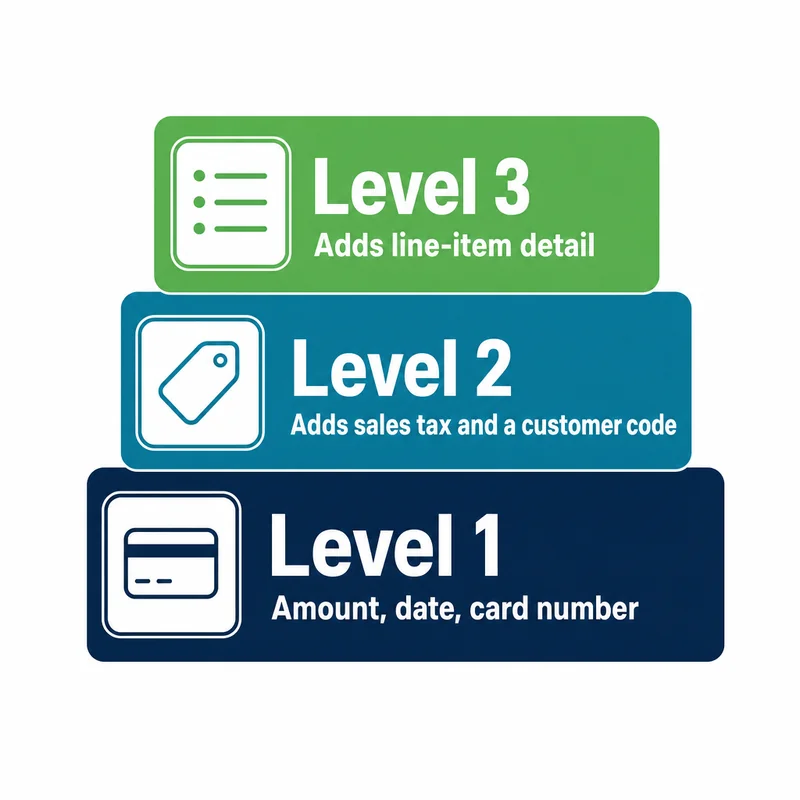
Level 3 credit card processing means sending invoice line items (each product’s description, quantity and unit price) along with a business, corporate or purchasing card payment, so the sale can qualify for a lower commercial interchange rate. Level 2 sends less: the sales tax amount and a customer code such as a purchase order number. Consumer cards never qualify for either, no matter how much data you send.
The rules moved a lot in 2025 and 2026. Visa replaced its Level 3 program with the Commercial Enhanced Data Program (CEDP), renamed the Level 3 rate Product 3, and retired Level 2 except for fleet fuel. Mastercard’s schedule still lists separate tiers, Data Rate II and Data Rate III, which processors map to Level 2 and Level 3. Every current rate below comes from Visa’s schedule effective April 18, 2026 or Mastercard’s effective April 17, 2026.
Whether to take cards on invoices at all is covered on the B2B and wholesale payments page; this guide stays on the data.
Which cards qualify, and why consumer cards never do
Enhanced data rates exist only for commercial cards, the cards banks issue to companies and public agencies for business spending. Visa’s rules define Level II enhanced data as data provided “in connection with a Commercial Visa Product Transaction,” and Visa’s schedule lists no Level 2 or Product 3 rate for any consumer card. Mastercard’s gateway documentation agrees: the extra data can help “if you accept business, corporate, or purchase cards.”
So when a customer pays an invoice with a personal rewards card, the line items change nothing on interchange.
| Card type | Visa (schedule effective April 18, 2026) | Mastercard (schedule effective April 17, 2026) |
|---|---|---|
| Purchasing cards, including government purchasing cards | Eligible for Product 3 and Large Ticket | Eligible for Data Rate II and Data Rate III |
| Corporate cards | Eligible for Product 3 and Large Ticket | Eligible for Data Rate II and Data Rate III |
| Fleet cards | Eligible for Product 3, with some exclusions; a separate Level II rate remains for fuel | Eligible for Data Rate II and Data Rate III |
| Small business credit cards | Eligible for Product 3 since October 2025 | Data Rate II only; no Data Rate III is published |
| Business debit cards | Not eligible; the program covers credit and prepaid cards | Data Rate II is listed for unregulated commercial debit |
| Consumer credit and debit cards | Never eligible | Never eligible |
Government buyers fit in through purchasing cards, which Visa’s rules define as cards issued to commercial entities, “public and private.”
Your type of business matters too. Processor notices list the merchant categories Visa’s program excludes: airlines, car rental, lodging, passenger rail, cruise lines, travel agencies, and restaurants, including fast food.
What Level 2 and Level 3 data contain
Mastercard’s June 2026 starter guide for B2B sellers puts it simply: Level I covers basic information like amount, date and merchant, Level II adds sales tax and customer reference numbers, and Level III adds line-item details, such as product codes and quantities.
| Level | What it adds | Typical fields |
|---|---|---|
| Level 1 | The basics every card sale carries | Amount, date, card number and your merchant details |
| Level 2 | Order-level tax and a reference | Sales tax amount (or a tax-exempt flag) and a customer code such as a PO, invoice or cost-center number |
| Level 3 | Line-item detail, like the invoice itself | Per line: item name, product code or SKU, commodity code, quantity, unit of measure, unit price, discount, tax and line total. Per order: freight, duty, and ship-from and ship-to ZIP codes |
The April 2026 Visa Core Rules and Visa Product and Service Rules draw nearly the same lines: Level II enhanced data is the sales tax amount plus a customer code (cost center, general ledger number, or order or invoice number), and enhanced transaction-level data adds a description of items purchased, cost per unit and number of units.
The line items also have to add up. Per Checkout.com’s developer documentation, each line total is quantity times unit price, less any discount, and the line totals, less order discounts, plus tax and shipping, must equal the order amount. It warns that with Visa and Mastercard, payments that do not reconcile may incur additional fees.
How Visa changed Level 3 credit card processing in 2025 and 2026
Visa moved its Level 2 and Level 3 programs into CEDP, which reviews the quality of the data itself. PayPal’s February 2026 merchant notice calls Product 3 the new interchange classification replacing Commercial Level III.
| Date | What changed at Visa | Where the date comes from |
|---|---|---|
| April 12, 2025 | CEDP launched, with a program fee of 0.05% on participating transactions | Stripe and NMI processor notices |
| October 18, 2025 | Product 3 replaced Commercial Level III: 1.90% + $0.10 became 1.75% + $0.10 on corporate and purchasing cards, and Large Ticket went from 1.45% + $35.00 to 1.30% + $35.00. Small business credit cards became eligible, at 1.75% + $0.10 on Tier I | Visa’s schedules dated October 19, 2024 and October 18, 2025 |
| January 24, 2026 | Visa raised Business Product 3 on Tier I small business credit cards to 2.40% + $0.10 | PayPal and Stripe notices; the rate matches Visa’s April 18, 2026 schedule |
| April 18, 2026 | Level 2 retired, except Commercial Level II Fuel for fleet cards | Visa’s April 18, 2026 schedule |
The practical result as of September 2026: on a Visa commercial card, sending tax and a PO number no longer earns a lower rate by itself. The only Level 2 rate left in the Visa interchange schedule is Commercial Level II Fuel, at 2.20% + $0.10.
Mastercard did not follow. Its schedule effective April 17, 2026 still lists Data Rate II and Data Rate III for commercial credit, the tiers processors map to Level 2 and Level 3. Checkout.com also told merchants that from October 17, 2025, Mastercard would require more specific units of measure in that data.
Selected current commercial card rates, with their dates
These are selected interchange rates only, paid to the card-issuing bank; your processor’s markup and other network fees sit on top. Small business cards are priced in five spend tiers, and the tables show the lowest, Tier I. The full Visa schedule and Mastercard schedule list more, including Visa’s purchasing-only Government-to-Government (G2G) and GSA Large Ticket rates and Mastercard’s Data Rate II for petroleum merchant categories.
Visa, effective April 18, 2026
| Card | Category | When it applies | Rate |
|---|---|---|---|
| Corporate and purchasing (includes fleet) | Commercial Product 3 | Line items pass Visa’s review | 1.75% + $0.10 |
| Corporate and purchasing | Commercial Product Large Ticket | Line items pass review; sale qualifies as Large Ticket | 1.30% + $35.00 |
| Corporate and purchasing | Commercial Card Present | Card present, without Product 3 data | 2.50% + $0.10 |
| Corporate and purchasing | Commercial Card Not Present | Keyed or online, without Product 3 data | 2.70% + $0.10 |
| Corporate and purchasing | Non-Qualified | Qualifies for no other category | 2.95% + $0.10 |
| Small business, Tier I | Business Product 3 | Line items pass Visa’s review | 2.40% + $0.10 |
| Small business, Tier I | Business Product 2 | Card present, without Product 3 data | 1.90% + $0.10 |
| Small business, Tier I | Business Product 1 | Keyed or online, without Product 3 data | 2.65% + $0.10 |
| Small business, Tier I | Business Non-Qualified | Qualifies for no other category | 3.15% + $0.20 |
Visa’s business table does not label which sale each row covers. In its consumer tables, Visa lists Product 2 with card-present programs and Product 1 with card-not-present programs, and Checkout.com’s Level 2 and Level 3 documentation gives 2.65% + $0.10, the Business Product 1 Tier I rate, as the card-not-present rate for business credit. On small business cards, the card-present rate is below Business Product 3.
Mastercard, effective April 17, 2026
| Card | Category | Rate |
|---|---|---|
| Large Market Credit | Data Rate III | 1.90% + $0.10 |
| Large Market Credit | Data Rate II | 2.50% + $0.10 |
| Large Market Credit | Data Rate I | 2.70% + $0.10 |
| Large Market Credit | Large Ticket | 1.45% + $35.00 |
| Large Market Credit | Standard | 2.95% + $0.10 |
| Small Business Credit, Business Core | Data Rate II | 1.90% + $0.10 |
| Small Business Credit, Business Core | Data Rate I | 2.65% + $0.10 |
| Small Business Credit, Business Core | Standard | 2.95% + $0.10 |
Large Market Credit is Mastercard’s column for commercial credit cards outside its small business table, which has no Data Rate III row. That matches processor documentation limiting Mastercard Level 3 to corporate, purchasing and fleet cards.
Check the date on any rate you are quoted: Mastercard says it typically updates rates semiannually, and Visa publishes dated editions.
Worked example: one invoice, four possible outcomes
Say you invoice a customer $20,000 and they pay with a Visa purchasing card that you key in as a card-not-present sale. The table uses Visa’s rates effective April 18, 2026 and counts only interchange plus Visa’s 0.05% program fee, not processor markup or other network fees.
| What happens to the data | Visa category and rate | Interchange | Program fee | Total |
|---|---|---|---|---|
| No line items sent | Commercial Card Not Present, 2.70% + $0.10 | $540.10 | None | $540.10 |
| Line items sent but fail Visa’s review | Commercial Card Not Present, 2.70% + $0.10 | $540.10 | $10.00 | $550.10 |
| Line items pass Visa’s review | Commercial Product 3, 1.75% + $0.10 | $350.10 | $10.00 | $360.10 |
| Line items pass review; sale qualifies as Large Ticket | Commercial Product Large Ticket, 1.30% + $35.00 | $295.00 | $10.00 | $305.00 |
Here, good data is worth $180.00 on one invoice, even after the program fee, and data that fails review costs $10.00 more than sending none. The second row follows processor notices: the fee applies when a transaction carries Visa’s enhanced-data flag and Visa reviews it, pass or fail.
Now suppose a different customer pays a $5,000 invoice with a Visa small business card at Tier I, again keyed in. Without qualifying data, Business Product 1 at 2.65% + $0.10 comes to $132.60. With line items that pass review, Business Product 3 at 2.40% + $0.10 is $120.10, plus a $2.50 program fee, for $122.60. The difference is $10.00. Under Visa’s schedule effective October 18, 2025, Product 3 on that card was 1.75% + $0.10, and the same sale would have cost $90.10 with the fee.
What finally matters is your total cost across every card type: your effective rate versus the headline rate you were quoted. Level 3 data moves that number only as far as your commercial card volume allows.
What Visa checks in your line items
Under CEDP, Visa reviews the content of the data, not only whether the fields are filled in. Stripe’s CEDP support page summarizes the data problems Visa has flagged:
- Product names that are blank, a single character, generic, or that repeat any part of your business name
- Product codes or descriptions that are blank or generic, or that hold something else, such as a merchant category code
- Tax amounts that are wrong for the location, or the same fixed amount on every sale (a zero amount is fine where no sales tax applies)
- A blank unit of measure. The unit should match how the item is counted or measured, such as each or gallon
Timing differs too. Processor notices describe two paths: a business Visa has verified receives Product 3 at settlement; otherwise the sale settles at the standard commercial rate, and Visa credits the difference after the data passes review.
Stripe adds that Visa paused verifying new businesses in November 2025. Individual transactions still qualify, but for a new business the lower rate arrives as an adjustment, not at settlement.
The sale must also meet each network’s basic qualification rules. Mastercard, for example, lists the time between authorization and clearing among its rate requirements.
Setting up Level 2 and Level 3 data: a checklist
- Pull a recent month of card sales and sort the commercial cards by network and type: purchasing, corporate, fleet and small business.
- Confirm your merchant category is not one Visa’s program excludes, such as travel, lodging or restaurants.
- Check whether your invoicing, ERP or online store can pass line items to your gateway automatically.
- Clean up your product catalog: real item names, SKUs, commodity codes and a unit of measure for every item.
- Make sure line totals, tax, freight, duty and discounts reconcile to the amount you charge.
- Run a few test sales on commercial cards and read the category each one lands in on your statement.
- After launch, keep checking the categories. A gateway accepting your data is not proof it qualifies; Mastercard’s gateway documentation says the provider does not validate that.
Questions to ask your provider
- Does my gateway send line items to both Visa and Mastercard, in the format each network now expects?
- Is Visa’s program fee passed through at cost, and is there a separate charge for Level 3 support?
- How do Visa’s after-review adjustments appear, and on which statement?
- If my data fails Visa’s review, who tells me, and what report shows the errors?
What to check on your statement
Look for the commercial categories by name: Commercial Product 3 or Business Product 3 on Visa, and Data Rate II or Data Rate III on Mastercard. If keyed commercial card sales keep landing in Commercial Card Not Present or Business Product 1 on Visa, or Data Rate I or Standard on Mastercard, the data is missing or not qualifying.
You can only see this if your statement breaks out interchange categories. If it shows one blended rate per card type, the interchange-plus pricing page explains the billing format that does. For unfamiliar line items, the merchant statement fee dictionary defines them. Your processor and your signed agreement settle how any of this applies to your account.
Frequently Asked Questions
What is level 2 and level 3 processing?
It means sending extra transaction data with a commercial card payment. Level 2 adds the sales tax amount and a customer code such as a PO number. Level 3 adds line items: description, product code, quantity, unit of measure and unit price. On eligible business, corporate and purchasing cards, the data can qualify a sale for lower interchange. Since April 18, 2026, only line-item data earns a lower rate at Visa, apart from fleet fuel.
How much is level 3 data?
Sending Level 3 data has two kinds of cost. Processor notices report that Visa charges a program fee of 0.05% on transactions that carry its enhanced-data flag, whether or not the data passes review. Your gateway or software provider may also charge for Level 3 support, which varies by provider. Against that, a Visa purchasing card sale keyed in costs 2.70% + $0.10 in interchange without qualifying data and 1.75% + $0.10 with it, as of April 18, 2026.
What data is required for Mastercard Level 3 transactions?
Level 3 builds on Level 2, starting with the sales tax amount and an order or PO reference. Mastercard’s gateway requires at least a name, quantity and unit price per line item; processor documentation adds product code, commodity code, unit of measure, line tax, discount and line total, plus freight and duty. Checkout.com told merchants that Mastercard would require more specific units of measure from October 17, 2025. Mastercard’s schedule calls the rate Data Rate III, which processors map to Level 3 and limit to corporate, purchasing and fleet cards.
Do consumer credit cards qualify for Level 3 rates?
No. Level 2 and Level 3 rates exist only for commercial cards: business, corporate, purchasing and fleet cards. Visa defines Level II enhanced data as data sent with a commercial Visa product transaction, and neither network’s current schedule lists an enhanced-data rate for consumer cards. A customer who pays an invoice with a personal rewards card is charged the consumer rate, however detailed your line items are.
Does Visa still have Level 2 rates?
Only for fleet fuel. Visa’s interchange schedule effective April 18, 2026 lists Commercial Level II Fuel at 2.20% + $0.10 and no other Level 2 rate. Every other enhanced-data rate on Visa commercial cards now runs through the Commercial Enhanced Data Program, which requires line items that pass Visa’s data review. Mastercard still lists Data Rate II, which processors map to Level 2.
What is Visa Product 3?
Product 3 is Visa’s name for the rate that replaced Commercial Level III on October 18, 2025. It applies to U.S. commercial card sales that carry line-item data meeting the standards of Visa’s Commercial Enhanced Data Program. As of April 18, 2026, it is 1.75% + $0.10 on corporate and purchasing cards and starts at 2.40% + $0.10 on small business credit cards, rising with the card’s spend tier.
Is Level 3 processing worth it for a small business?
It depends on which cards your customers use. On Visa corporate and purchasing cards, Product 3 sits almost a full percentage point below the card-not-present rate as of April 18, 2026. On small business credit cards keyed in or taken online, the gap is a quarter of a point, before Visa’s program fee. If most of your B2B sales arrive on small business cards, the setup work may take longer to pay back than the headline numbers suggest.
Related guides
- Effective Rate vs Headline Rate: What You Are Actually Paying
- ACH and Bank Transfer Payments for Small Business
Sources
- Visa USA Interchange Reimbursement Fees (rates effective April 18, 2026), Visa
- Visa USA Interchange Reimbursement Fees (rates effective October 18, 2025), archived copy, Visa, via the Internet Archive
- Visa USA Interchange Reimbursement Fees (October 19, 2024 edition), archived copy, Visa, via the Internet Archive
- Visa Core Rules and Visa Product and Service Rules (April 18, 2026), Visa
- Mastercard 2026-2027 U.S. Region Interchange Programs and Rates (effective April 17, 2026), Mastercard
- Mastercard Interchange Fees and Rates Explained, Mastercard
- B2B card acceptance: a starter guide for businesses (June 23, 2026), Mastercard
- Level 2 and 3 Data (Mastercard Gateway documentation), Mastercard
- Visa’s Commercial Enhanced Data Program (February 17, 2026), PayPal
- Understand the Visa Commercial Enhanced Data Program (CEDP), Stripe
- Changes to commercial interchange in the US, Checkout.com
- Submit Level 2 or Level 3 data, Checkout.com
- Everything you need to know about Visa CEDP, NMI
This article is general information for business owners, not legal, tax, or accounting advice. Card brand rules, interchange schedules, and processor agreements change; confirm specifics against your own statement and your own signed agreement.