
By Jeremy
Published September 26, 2026

As of September 26, 2026, the Illinois Interchange Fee Prohibition Act is not in effect. The legislature has moved its start date twice, most recently to July 1, 2027, and a federal court in Chicago has permanently barred the Illinois Attorney General from enforcing its interchange rule against national banks, federal credit unions, federal savings associations, out-of-state banks covered by a federal branching statute, and the card networks.
Below: what the Act says, how its start date moved, who the court orders cover and why, what is still open, and which records and questions matter in the meantime. Each legal point cites the statute, a court filing or a federal notice, and none of it predicts how the case ends.
What the Illinois Interchange Fee Prohibition Act says
The Act is Article 150 of Public Act 103-0592, a broad revenue law that became law on June 7, 2024. It is compiled at 815 ILCS 151, Article 150 on the General Assembly’s website. It has two working parts, which the federal court calls the Interchange Fee Limitation and the Data Usage Limitation.
The interchange part (Section 150-10)
Section 150-10(a) says an issuer, a payment card network, an acquirer bank or a processor may not receive or charge a merchant any interchange fee on the tax amount or the gratuity of a card transaction, if the merchant sends the tax or tip amount as part of authorization or settlement. The Act defines a merchant as a person that collects and remits a tax, and it defines an interchange fee as a fee a card network sets, charges or receives to compensate the card issuer.
If the merchant does not send those amounts with the transaction, Section 150-10(b) provides a second route: the merchant may submit tax documentation to the acquirer bank or its designee no later than 180 days after the transaction, and the issuer must credit the interchange charged on the tax or tip within 30 days after the documentation is submitted. The statute lists invoices, receipts, journals, ledgers and filed tax returns as examples of tax documentation.
Section 150-10(c) says the Act does not make a card network liable for the accuracy of the tax or tip data a merchant reports. Section 150-10(d) makes it unlawful to raise interchange on the rest of the transaction to get around the rule.
The data part and the penalties (Section 150-15)
Section 150-15(a) sets a civil penalty of $1,000 per transaction for an issuer, network, acquirer bank, processor or other designated entity that received the tax or tip data and still violates Section 150-10, and the issuer must refund the interchange charged on that amount.
Section 150-15(b) says that anyone other than the merchant who helps process a card transaction may not distribute, exchange, transfer or use the transaction data except to process the transaction or as required by law. A violation counts as a violation of the Illinois Consumer Fraud and Deceptive Business Practices Act.
What the Act is not
The Act is not a surcharging law. For how surcharges work under card network rules, see our explainer on what surcharging is. The Act does not address what a merchant may charge a customer. It addresses what the card side of the transaction may charge a merchant.
It is also not a general cap on interchange. Section 150-10 reaches interchange on the tax and tip portion of a sale; interchange on the goods or services themselves stays outside it, apart from the anti-circumvention clause in Section 150-10(d).
Nor does it set rules for the markup or service fees in a processing agreement. Interchange is one layer of what a merchant pays, and interchange-plus pricing shows how the layers look when itemized.
When the Act takes effect, and how the date moved
Section 999-99 of the compiled statute now says Article 150 takes effect July 1, 2027. That is the third date the legislature has set, and the lawsuit has run alongside each change.
| Date | What happened | Source |
|---|---|---|
| June 7, 2024 | Public Act 103-0592 becomes law and sets a July 1, 2025 start date for the Act | PA 103-0592, Sec. 999-99 |
| August 15, 2024 | Four bank and credit union groups, led by the Illinois Bankers Association, sue the Illinois Attorney General in federal court | Dkt. 225 (N.D. Ill. No. 1:24-cv-07307) |
| December 20, 2024 and February 6, 2025 | Preliminary injunctions for national banks, federal savings associations and out-of-state state banks; denied for federal credit unions | Dkts. 104, 115 |
| June 16, 2025 | Public Act 104-0004 moves the start date to July 1, 2026 | PA 104-0004 |
| February 10, 2026 | Summary judgment: data-use limit enjoined for listed institutions; interchange limit not enjoined | Dkt. 179 |
| April 29, 2026 | OCC publishes an interim final rule and a preemption order for national banks and federal savings associations, both effective June 30, 2026 | 91 FR 22989; 91 FR 23150 |
| May 8, 2026 | Seventh Circuit vacates the February judgment and sends the case back to weigh the OCC actions first | 7th Cir. No. 26-1354 and consolidated appeals |
| June 1, 2026 | Interchange limit permanently enjoined for national banks, covered out-of-state banks, federal savings associations and card networks; formal injunction entered June 10 | Dkts. 223, 225 |
| June 9, 2026 | NCUA publishes an interim final rule for federal credit unions, effective June 30, 2026 | 91 FR 34725 |
| June 26, 2026 | Public Act 104-0532 moves the start date to July 1, 2027 | PA 104-0532, Sec. 70 |
| September 22, 2026 | Federal credit unions added to the interchange injunction | Dkt. 240 |
| September 23, 2026 | Plaintiffs and the Attorney General jointly ask the court to enter an agreed final judgment and permanent injunction | Dkt. 241 |
When reading older coverage, note that the February 2026 ruling said the law “now goes into effect July 1, 2026.” That was accurate then. Public Act 104-0532, effective June 26, 2026, replaced it with July 1, 2027.
Who the Act cannot be enforced against right now, and why
The case is Illinois Bankers Association v. Raoul, No. 1:24-cv-07307 in the Northern District of Illinois. As of September 26, 2026, the controlling orders are the June 10, 2026 permanent injunction and the September 22, 2026 opinion that added federal credit unions. Together they bar the Illinois Attorney General from enforcing the two parts of the Act as follows.
| Type of institution | Interchange limit (Sec. 150-10) | Data-use limit (Sec. 150-15(b)) |
|---|---|---|
| National banks | Enjoined | Enjoined |
| Federal savings associations | Enjoined | Enjoined |
| Federal credit unions | Enjoined (added September 22, 2026) | Enjoined |
| Banks chartered by other states and subject to 12 U.S.C. 1831a(j)(1) | Enjoined | Enjoined |
| Payment card networks | Enjoined | Enjoined when carrying out functions for the institutions above |
| Processors | Not named in the interchange injunction | Enjoined when carrying out functions for the institutions above |
| Credit unions, savings associations and savings banks chartered by other states | Not covered | Not covered |
| Institutions chartered by Illinois | Not before the court | Not before the court |
Why: federal preemption
The reasoning rests on the Supremacy Clause, under which a valid federal law controls over a conflicting state law. For national banks, the court applied the Supreme Court’s Barnett Bank standard as restated in Cantero v. Bank of America (2024): whether the state law prevents or significantly interferes with a national bank’s exercise of its federal powers.
In February 2026 the court held that the interchange limit was not preempted under that test, because the card networks, not the banks, set interchange. Then the OCC rewrote its fee rule, 12 C.F.R. 7.4002, effective June 30, 2026, to say a national bank may obtain fees through payment networks and other third parties. In its June 1, 2026 opinion, the court held that with that power in place, the Act is “an obstacle” to it, and that the preemptive effect “must run to the Payment Card Networks.”
The court said it did not find the OCC’s separate preemption order “particularly persuasive”; the result turned on the rewritten rule. It applied the same result to federal savings associations and covered out-of-state banks, and in September, after the NCUA adopted a similar interim rule, to federal credit unions. On the data-use limit, the September opinion says the February ruling’s assessment “still stands in full.”
How the tax and tip exclusion would work on one sale
The mechanics are easiest to see on one transaction. The figures below are made up for illustration; they are not card network rates or fees.
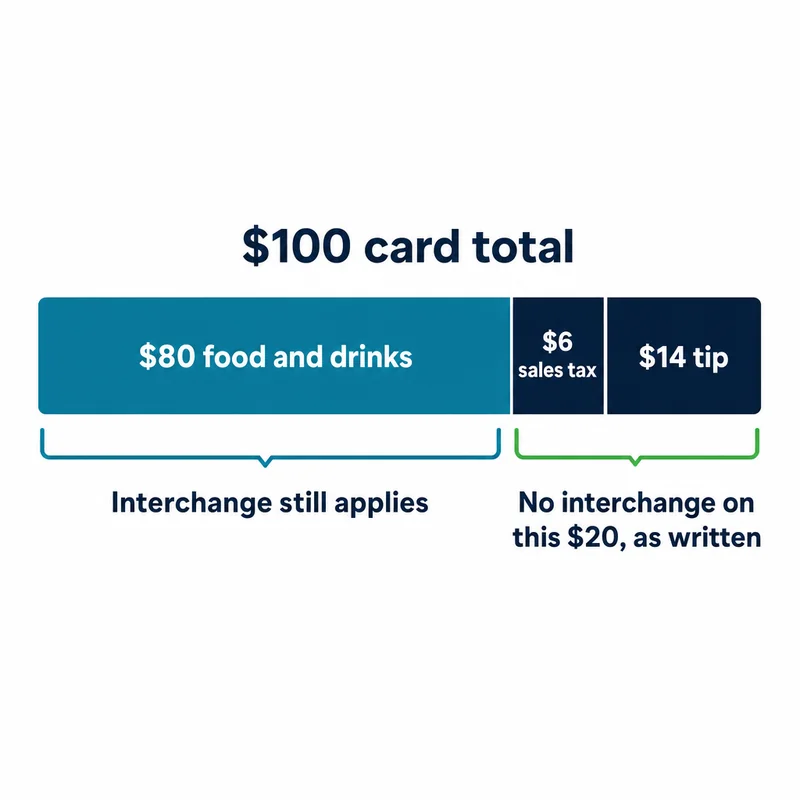
Say you run a restaurant in Illinois and a guest pays a $100 card total, made up of $80 for food and drinks, $6 of sales tax and a $14 tip. In this example, the tax and tip together come to $20.
- If your system sends the $6 tax and the $14 tip as separate amounts in the authorization or settlement data, Section 150-10(a), as written, would bar interchange on that $20 in this example. Interchange would still apply to the $80.
- If those amounts are not sent with the transaction, Section 150-10(b) lets you submit tax documentation within 180 days, and the issuer then has 30 days after you submit it to credit the interchange charged on the $20 in this example.
- Either way, the Act does not apply before July 1, 2027, and whether a particular sale would qualify depends on who issued the card and who else handles it, which the court orders answer only in part.
No savings figure is shown on purpose. Interchange varies by card and transaction type, the Act does not set a rate, and it is not in effect.
What is still unresolved
- The agreed final judgment. On September 23, 2026, the plaintiffs and the Attorney General jointly asked the court to enter an agreed stipulation of final judgment and permanent injunction (Dkt. 241). The proposed terms are not in the public copy on CourtListener, and no ruling on the motion appeared there as of September 26, 2026.
- Appeals. When the Seventh Circuit sent the case back on May 8, 2026, it said any further appeals will return to the same panel. The September 22 opinion refers to the parties re-instituting their appeal, but no new notice of appeal appears on the public docket as of September 26, 2026.
- Interim federal rules. The OCC and NCUA rules the court relied on are interim final rules, effective June 30, 2026. A Federal Register search on September 26, 2026 found no final version of either.
- Banks chartered in other states. The FDIC’s State Bank Parity proposal of September 22, 2026 would apply host-state laws to out-of-state state banks, with or without a branch in the state, only to the same extent those laws apply to national banks, and it cites this case. It is a proposal, with comments due November 23, 2026.
- Illinois-chartered institutions. The court said the Act’s application to institutions chartered by Illinois “is not in front of this Court.” Credit unions, savings associations and savings banks chartered by other states are also outside the injunctions.
- How the remainder would work. The court described the result as leaving the Act “enjoined as to most, but not all, entities” and said compliance with what remains “may still prove overwhelmingly arduous for some remaining financial institutions.”
None of this is a forecast. This page reflects the record as of September 26, 2026.
Records and questions while the status is unresolved
None of the points below depends on how the case ends. They describe the records the statute refers to, where interchange appears on a statement, and questions a merchant may put to its provider.
- Tax and tip as separate amounts. Section 150-10(a) turns on whether the tax or gratuity amount is transmitted as part of authorization or settlement. That depends on whether the point-of-sale system records those amounts as their own fields or folds them into the item total.
- The records the statute names. Section 150-5 lists invoices, receipts, journals, ledgers and filed tax returns as examples of tax documentation, and it allows documentation for a single transaction or for many transactions aggregated over a period of time.
- Where interchange appears on a statement. The guide on how to read a merchant services statement walks through the layout, and the merchant statement fee dictionary defines each line.
- Fee changes. Processing costs change for many reasons unrelated to this Act, which the explainer on why credit card processing fees go up covers.
- Official status sources. The statute page on the General Assembly’s website carries the current effective date in Section 999-99, and the federal docket for No. 1:24-cv-07307 lists new orders.
Questions a merchant may put to its provider
- Whether the point of sale sends sales tax and tip amounts as separate fields in authorization or settlement data.
- Whether statements separate tax and gratuity amounts, and how interchange on them would appear if the Act takes effect.
- Whether any notice or new line item mentions Illinois, tax or gratuity data.
- Which card issuers and networks the provider expects the Act to reach after the court’s orders.
- Whether any fee in the agreement would change because of the Act, and whether written notice would come first.
- Who the acquirer bank or designee is for tax documentation, and what format it accepts.
PayPoint Systems, an independent merchant services provider in Northwest Indiana, reviews statements with merchants, and these questions suit that conversation or one with a processor. For how the Act applies to a particular business, the right sources are its processor, its agreement and its own counsel.
Frequently Asked Questions
What is the new law in Illinois regarding credit cards?
The one most merchants mean is the Interchange Fee Prohibition Act, 815 ILCS 151, Article 150. It would bar interchange on the sales tax and tip portion of debit and credit card sales when the merchant reports those amounts, and it limits how the companies that handle a card sale may use its data. As of September 26, 2026 it is not in effect, its start date is July 1, 2027, and a federal court has blocked it for many institutions.
What are the changes in Illinois credit card law for 2026?
Two things changed in 2026, and neither put the Act into effect. Public Act 104-0532, effective June 26, 2026, moved its start date from July 1, 2026 to July 1, 2027. And federal court orders on June 1, June 10 and September 22, 2026 permanently barred the Attorney General from enforcing the interchange rule against national banks, federal savings associations, federal credit unions, covered out-of-state banks and card networks.
Is the Illinois Interchange Fee Prohibition Act in effect?
No. As of September 26, 2026, Section 999-99 of the statute says Article 150 takes effect July 1, 2027. Separately, a federal court has permanently enjoined the Illinois Attorney General from enforcing the interchange rule against several groups of institutions and the card networks, and the data rule against a similar list. Parts of the case are still open, including a joint motion for an agreed final judgment filed September 23, 2026.
Who gets paid the interchange fee?
The card issuer, meaning the bank or credit union that issued the customer’s card. The Illinois statute defines an interchange fee as a fee a payment card network sets, charges or receives to compensate the issuer for its involvement in the transaction. Section 150-10(a) treats it as a fee charged to the merchant, and on an itemized statement it sits alongside the processor’s and provider’s own fees.
Do interchange fees apply to debit cards?
Yes. Under the Illinois Act’s definitions, interchange is tied to any electronic payment transaction, which covers debit cards, credit cards and general use prepaid cards issued through a card network. The court’s current injunctions are written by type of institution, such as national banks or federal credit unions, and they do not draw a line between debit and credit cards.
What are interchange fees and what are their purposes?
Interchange is the fee the card networks set that flows to the card issuer on each card sale. Under the Illinois statute’s definition, its purpose is to compensate the issuer for its involvement in the transaction. On an itemized, interchange-plus statement it appears separately from network fees and from the processor’s or provider’s own markup. The Act would change interchange only on the tax and tip portion of a sale.
Related guides
Sources
- 815 ILCS 151, Article 150 (Interchange Fee Prohibition Act) and Section 999-99, Illinois General Assembly
- Public Act 104-0532 (SB3645), Section 70, Illinois General Assembly
- Bill Status of SB3645, 104th General Assembly, Illinois General Assembly
- Public Act 104-0004 (HB0742), Illinois General Assembly
- Public Act 103-0592 (HB4951), Illinois General Assembly
- Illinois Bankers Ass’n v. Raoul, Memorandum Opinion and Order, Dkt. 104 (Dec. 20, 2024), U.S. District Court for the Northern District of Illinois (via CourtListener)
- Illinois Bankers Ass’n v. Raoul, Memorandum Opinion and Order, Dkt. 115 (Feb. 6, 2025), U.S. District Court for the Northern District of Illinois (via CourtListener)
- Illinois Bankers Ass’n v. Raoul, Memorandum Opinion and Order, Dkt. 179 (Feb. 10, 2026), U.S. District Court for the Northern District of Illinois (via CourtListener)
- Illinois Bankers Ass’n v. Raoul, Order, Nos. 26-1354, 26-1371, 26-1440 and 26-1441 (May 8, 2026), U.S. Court of Appeals for the Seventh Circuit (via CourtListener)
- Illinois Bankers Ass’n v. Raoul, Memorandum Opinion and Order, Dkt. 223 (June 1, 2026), U.S. District Court for the Northern District of Illinois (via CourtListener)
- Illinois Bankers Ass’n v. Raoul, Order Entering a Permanent Injunction, Dkt. 225 (June 10, 2026), U.S. District Court for the Northern District of Illinois (via CourtListener)
- Illinois Bankers Ass’n v. Raoul, Memorandum Opinion and Order, Dkt. 240 (Sept. 22, 2026), U.S. District Court for the Northern District of Illinois (via CourtListener)
- Illinois Bankers Ass’n v. Raoul, Joint Consent Motion for Entry of Stipulation of Final Judgment and Permanent Injunction, Dkt. 241 (Sept. 23, 2026), U.S. District Court for the Northern District of Illinois (via CourtListener)
- Docket, Illinois Bankers Association v. Raoul, No. 1:24-cv-07307, CourtListener (Free Law Project)
- National Bank Non-Interest Charges and Fees, interim final rule, 91 FR 22989 (Apr. 29, 2026), Office of the Comptroller of the Currency (Federal Register)
- Order Preempting the Illinois Interchange Fee Prohibition Act, 91 FR 23150 (Apr. 29, 2026), Office of the Comptroller of the Currency (Federal Register)
- Preemption: Federal Credit Union Non-Interest Charges and Fees, interim final rule, 91 FR 34725 (June 9, 2026), National Credit Union Administration (Federal Register)
- State Bank Parity, notice of proposed rulemaking, 91 FR 60018 (Sept. 22, 2026), Federal Deposit Insurance Corporation (Federal Register)
This article is general information for business owners, not legal, tax, or accounting advice. Card brand rules, interchange schedules, and processor agreements change; confirm specifics against your own statement and your own signed agreement.