
By Jeremy
Published September 26, 2026
An authorization hold is the amount a customer’s card issuer sets aside when a card is approved, before the sale is final. No money moves at that point. The hold lowers the customer’s available credit, or the available balance in their checking account on a debit card, until the merchant captures the final amount or sends a reversal and the issuer lifts the hold.
The card networks set how long an authorization stays valid for capture, not how long the customer sees the hold. Visa’s April 2026 rules give most card-present sales 5 calendar days to be captured, customer-initiated online and phone orders 10 calendar days, and hotel, cruise line, and vehicle rental estimates 30 calendar days. Mastercard’s June 2026 rules allow 30 calendar days for a preauthorization and 7 calendar days for a final authorization. When the hold actually drops off is up to the customer’s card issuer.
How an authorization hold works: authorization, capture, and settlement
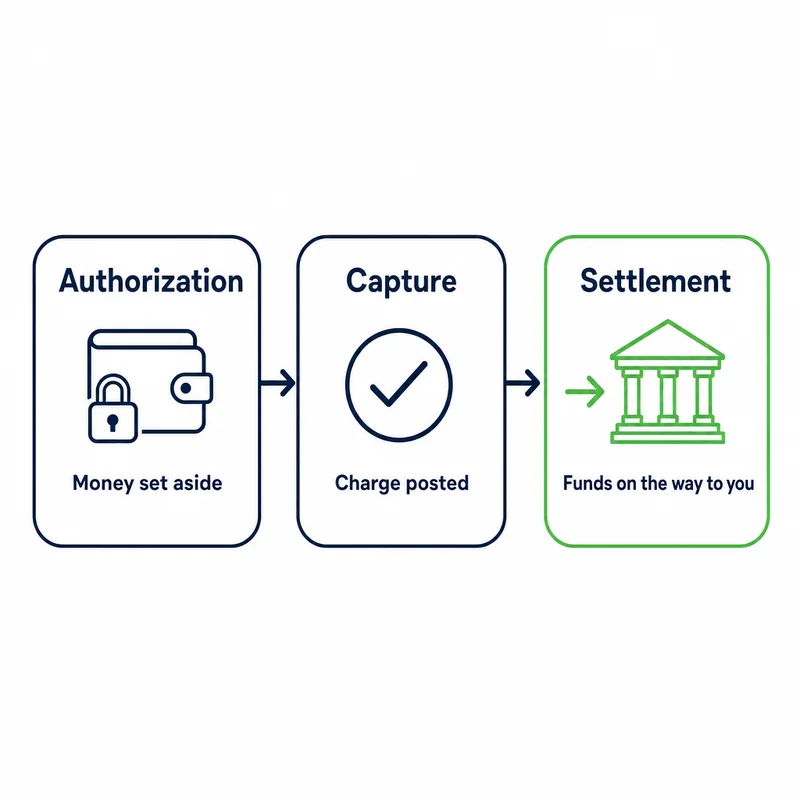
Every card sale runs through three steps, and the hold lives in the first one.
| Step | What happens | Where the customer’s money is |
|---|---|---|
| Authorization | The card issuer approves an amount and reduces the customer’s available funds by that amount. | Still in the customer’s account, but set aside |
| Capture (clearing) | The merchant sends the final amount, often when the batch closes, and the issuer matches it to the authorization. | Posted to the customer’s account as a charge |
| Settlement | Funds move through the card network to the merchant’s bank account. | On its way to the merchant |
Visa’s merchant guidance on estimated authorizations and reversals notes that when a sale is never captured or reversed, the hold keeps tying up the customer’s money, and merchants often take the blame.
One point trips up owners: the hold sits on the customer’s card, not on your money. It is a different thing from a reserve or a paused payout on your side, which our guide to why card deposits do not match sales covers.
When businesses use an authorization hold
A hold earns its keep when the final amount is unknown at the moment the card is presented, or when the sale might not happen at all, as when a hotel guest or rental customer may pay another way at the end. Mastercard’s term for this kind of hold is a preauthorization, often written pre-authorization.
- Hotels and lodging. The card is authorized at check-in for an estimate of the stay and captured at checkout. See our page on retail and hospitality payments.
- Vehicle and equipment rentals. Car, boat, bike, tool, and motor home rentals authorize an estimate at pickup and capture the final amount at return.
- Bar tabs and restaurant tips. A tab is opened on a card and closed later, and a tip is often added after approval. The limits on how far the final amount can move are covered below and in our restaurant POS and payment processing overview.
- Fuel. Pay-at-the-pump terminals authorize before fueling. Visa’s rules require a completion or a reversal within 2 hours of the approval for a fuel dispenser preauthorization.
- Deposits on custom work. Usually a poor fit, since Visa does not allow an estimated authorization for an advance payment. A deposit is normally a real charge, and Visa requires the customer’s express informed consent to an agreement showing the goods or services, total price, and cancellation and refund policy.
Across all of these, a few habits keep holds from turning into complaints:
How long an authorization stays valid under Visa and Mastercard rules
There is no single validity period for every card. Visa sets its capture deadline by type of business and sale, and Mastercard sets it by how the authorization was coded. On both, the clock starts on the date of the approval.
| Network and type of sale | Deadline to capture the sale |
|---|---|
| Visa: hotel, cruise line, or vehicle rental with an estimated authorization | 30 calendar days |
| Visa: other rentals with an estimated authorization (equipment, boats, bikes, motor homes, and similar) | 10 calendar days |
| Visa: online, phone, or mail order started by the customer | 10 calendar days, or 30 calendar days with Visa’s extended authorization indicator |
| Visa: all other card-present sales (restaurants, bars, retail counters) | 5 calendar days |
| Visa: merchant-initiated charges (recurring, installment, card on file) | 5 calendar days |
| Mastercard: preauthorization (an estimated amount, or a sale that may not complete) | 30 calendar days |
| Mastercard: final authorization (the exact amount, not expected to be cancelled) | 7 calendar days, and the captured amount must equal the authorized amount |
The Visa rows come from Table 5-12 of the Visa Core Rules and Visa Product and Service Rules (18 April 2026 edition), timeframes Visa adopted effective April 13, 2024. The Mastercard rows come from Sections 2.5 through 2.8 of the Mastercard Transaction Processing Rules (9 June 2026 edition). Mastercard’s older undefined authorization, with 7 calendar days, stopped applying in the US after June 16, 2025.
For long stays and rentals, a Visa incremental authorization does not extend the deadline, so a stay that runs past the window needs the original authorization reversed and a new one requested. Mastercard lets a merchant extend its protection period with an additional preauthorization for the same transaction, even for a zero amount.
Missing the deadline has a cost. A late Visa capture is open to Dispute Condition 11.3, No Authorization/Late Presentment. On Mastercard, an expired authorization is treated as zero, which exposes the sale to an authorization-related chargeback (reason code 4808).
These are deadlines for the merchant, not a promise about when the customer’s bank will lift the hold.
Estimated and incremental authorizations
An estimated authorization is a hold for your best estimate of the final bill, flagged so the issuer knows it is an estimate. Visa allows any merchant to use one when the final amount is not known. The main requirements:
- Tell the customer. Visa requires telling the cardholder the estimated amount and that more authorizations may follow, in writing or verbally. Mastercard requires disclosing the estimate and getting the cardholder’s consent before the request.
- Keep it genuine. Visa requires a genuine estimate that leaves out potential damage, theft, other delayed charges, insurance premiums, and tips. A Visa program for vehicle rental companies allows a higher estimate for extended rentals, but still excludes damage.
- Handle damage separately. Mastercard bars vehicle rental companies from including the insurance deductible or potential damages when the renter waives coverage, and requires loss, theft, or damage charges to be processed separately. Visa treats damage as a delayed charge with its own documentation rules.
- Top up with an incremental authorization. If the estimate runs short, an incremental authorization adds to it, using the same Transaction Identifier on Visa. Visa’s guide sets no limit on how many a merchant sends inside the validity window.
A worked example: a hotel stay that changes twice
Say a guest books three nights at $180 a night, taxes included. Here is how the hold moves in this example:
- At check-in, the hotel sends an estimated authorization for $540 and tells the guest the amount and that more authorizations may follow.
- The guest asks to add a fourth night. The hotel sends an incremental authorization for $180 with the same transaction identifier, bringing the total authorized to $720. On Visa, the validity window still counts from the first approval.
- Plans change again, and the guest checks out after three nights. The final bill is $540.
- The hotel captures $540 and reverses the $180 it no longer needs. Visa’s rules call for that partial reversal within 24 hours of completing the sale. Mastercard’s rules call for the same, unless the capture itself goes out within 24 hours.
The last step is the easiest to miss. Visa notes that when the issuer cannot match the messages, funds can stay held longer or even twice, which the guest may read as an extra charge.
How far the final amount can differ from the authorization
Visa’s rules require the captured amount to match the authorized amount unless a tolerance applies. Table 7-10 of the April 2026 rules sets these:
| Business type (Visa) | Allowed difference between authorized and captured amount |
|---|---|
| US restaurants, fast food, and caterers (effective February 21, 2026, up from 20% for restaurants and fast food before that date) | Up to 30% |
| Bars and taverns, taxis and limousines, beauty and barber shops, health and beauty spas | Up to 20% |
| Hotels and cruise lines | Up to 15% |
| Vehicle rental | The greater of 15% or $75 |
| Other customer-initiated online, phone, or mail orders | Up to 15% |
Mastercard’s tip rule for US-issued cards at US merchants works differently. The tip must be inside the authorization for a final authorization and for chip-and-PIN, contactless (tap), QR code, and most card-not-present sales. For key-entered, magnetic stripe, and chip-and-signature sales, and card-not-present restaurant orders, a tip of up to 30% can be added after approval; above that, a preauthorized sale needs an incremental authorization. Lodging, cruise line, and vehicle rental sales cannot exceed the authorized amount without one. Our guide to pay at the table for restaurants shows how these tip rules play out with tableside devices.
How authorization holds affect customers paying with debit cards
For a debit card customer, a hold is not an abstract credit limit. It reduces the money in their checking account until the sale is captured or the hold is released, so a generous estimate can leave them short for other bills.
Neither network gives you a release date to promise. Mastercard requires the issuer to release a held amount within 60 minutes of matching a reversal to the original authorization, and US Debit Mastercard issuers must support full and partial reversals. Visa requires the acquirer to forward a merchant’s reversal immediately. After that, timing belongs to the customer’s bank.
Partial approvals also come up: an approval for less than requested, with the customer paying the rest another way. Visa then requires the capture to match the approved amount.
What to tell customers is simple: the amount you are authorizing, that it is a hold and not the final charge, and that any unused part is reversed when the sale closes, but their bank controls when the hold disappears from their account.
Releasing a hold: authorization reversals
An authorization reversal is the message that cancels all or part of an approval and tells the issuer the hold should come off. Both networks put the merchant on a 24-hour clock, with one exception: Visa’s reversal table does not apply to automated fuel dispensers in the US (they follow the 2-hour rule above), and Mastercard’s reversal rule excludes automated fuel dispensers (MCC 5542).
| Situation | What the rules call for | Visa deadline | Mastercard deadline |
|---|---|---|---|
| Sale cancelled, voided, or paid another way | Full reversal of the authorized amount | Within 24 hours of the cancellation or the end of the validity window, whichever comes first | Within 24 hours of the cancellation |
| Final amount lower than the authorization | Partial reversal of the difference | Within 24 hours of completing the sale | Within 24 hours of finalizing, unless the capture goes out within 24 hours |
| Authorization sent in error | Full reversal | No separate Visa category; handled as a sale that was not completed | Within 24 hours of finding the error (effective July 1, 2026) |
Matching data lets the issuer find the hold. Visa allows one reversal to cover several authorizations only if all used the same Transaction Identifier, and Mastercard requires each reversal to reference the original authorization.
Watch how voids are handled. Mastercard names a voided sale as a cancellation that calls for a reversal within 24 hours, so confirm that your terminal or gateway sends one when you void. Our void vs. refund guide explains where a void ends and a refund begins.
Skipped reversals also cost money. Visa assesses a Misuse of Authorization System fee on approvals never matched to a capture or a reversal, and its guide names $1.00 test transactions, used instead of a zero-amount account verification, as a common cause. Our merchant statement fee dictionary explains this fee and where it sits on a statement.
Authorization hold checklist and questions to ask your provider
- Decide which sales need an estimate (stays, rentals, open tabs) and which get the exact amount.
- Tell the customer the estimated amount before you authorize it, and that more authorizations may follow.
- Keep damage, insurance, and tips out of the estimate.
- Use an incremental authorization, with the same transaction identifier, when the estimate runs short.
- Capture within the network’s window for that type of sale, and reauthorize long stays or rentals before Visa’s window ends.
- Send a partial reversal for any unused amount, and a full reversal when a sale is cancelled or paid another way, within 24 hours.
- Check a card with a zero-amount account verification, not a small test charge.
- Look for misuse of authorization fees on each monthly statement.
Questions to ask your provider:
- Does our terminal or gateway send estimated and incremental authorization indicators for our type of business?
- When we void a sale or close a tab for less than the authorized amount, does the system send a full or partial reversal automatically?
- Are our Mastercard authorizations coded as preauthorizations or final authorizations, and does that match how we operate?
- How soon after approval does our system capture each sale, and does anything sit open past Visa’s or Mastercard’s window?
- For online or phone orders that ship late, can we use Visa’s extended authorization indicator?
Your processor and your signed agreement are the final word on how your own setup sends these messages.
Frequently Asked Questions
What is an authorization hold?
An authorization hold is the amount a card issuer sets aside when a card is approved but before the sale is captured. No money has moved yet. The hold reduces the customer’s available credit or, on a debit card, the available balance in their checking account. The merchant ends it by capturing the final amount or sending a reversal. Otherwise, the issuer decides when to lift it, within an outer limit that Mastercard’s rules set.
How long do authorization holds last?
The card networks set capture deadlines, not a hold duration. Under Visa’s April 2026 rules, merchants have 5 calendar days to capture most card-present sales, 10 calendar days for customer-initiated online and phone orders, and 30 calendar days for hotel, cruise line, and vehicle rental estimates. Mastercard’s June 2026 rules allow 30 calendar days for a preauthorization and 7 calendar days for a final authorization. When the customer’s bank lifts an unused hold is up to that bank.
Are authorization holds refunded?
A hold is not a charge, so there is nothing to refund. If the sale is cancelled or comes in lower than the hold, the merchant sends an authorization reversal, and the issuer then returns the unused amount to the customer’s available balance. Visa and Mastercard both call for that reversal within 24 hours for most sales. If the merchant captures the full amount, the hold becomes the posted charge.
How do you get rid of an authorization hold?
The fastest route is a reversal from the merchant. Once the issuer matches a reversal to the original authorization, Mastercard requires the held amount to be released within 60 minutes. A customer can ask the merchant to confirm a reversal was sent, then ask their own bank about any hold that remains. Without a reversal, the hold stays until it is matched to a capture or the issuer releases it.
How long does it take for a hold to be released?
There is no single answer. After a reversal, Mastercard requires the issuer to release the held amount within 60 minutes of matching it to the original authorization. Without a reversal, Mastercard requires release no later than the end of the protection period, which is 30 calendar days for a preauthorization and 7 calendar days for a final authorization. Visa’s rules set deadlines for merchants rather than a release date, so timing then depends on the customer’s bank.
Can a merchant charge more than the authorization hold?
Only within limits. Visa allows the captured amount to differ from the authorization by set tolerances, such as up to 30% for US restaurants since February 21, 2026, up to 20% for bars, and up to 15% for hotels. Mastercard lets a tip of up to 30% be added after approval on certain US sales, such as signed or key-entered restaurant checks. Beyond those limits, the rules call for more authorization, typically an incremental authorization following an estimate or preauthorization.
Related guides
Sources
- Visa Core Rules and Visa Product and Service Rules (18 April 2026), Visa
- Estimated and Incremental Authorization and Reversal Processing Requirements for Visa Merchants (2024), Visa
- Authorization Framework Will Be Updated To Simplify Authorization Processing Time Frames, Visa Business News (19 October 2023), Visa
- Transaction Processing Rules (9 June 2026), Mastercard
This article is general information for business owners, not legal, tax, or accounting advice. Card brand rules, interchange schedules, and processor agreements change; confirm specifics against your own statement and your own signed agreement.